

Growing cannabis doesn't always mean letting a plant stretch to the ceiling. For indoor growers, keeping plants compact can make better use of limited space, improve light distribution and make the whole plant easier to manage.
If your're wondering how to manage cannabis plant height and keep plants short, the good news is that you don't need to fight the plant to achieve this. Cannabis responds to its environment, its genetics, and the way its growth is managed. With the right cultivar, some patience, and some TLC, growers can encourage a shorter, broader plant with a more even canopy.
Key Takeaways
- Choose genetics with naturally compact growth if plant height is a concern.
- Start shaping the plant while it is actively growing rather than waiting until it becomes too tall.
- Low-stress training can encourage horizontal growth wihtout removing large sections of the plant.
- Topping changes the plant's structure by removing the dominant growing tip and encouraging lateral branches.
- Light, photoperiod, and egentics all influence plant architecture, so training is only part of the picture.
- Avoid excessive pruning or training. More intervention isn't necessarily is better.
- Plan for the plant's eventual size before it reaches the flowering stages, when some varieties can stretch considerably.
How To Manage Cannabis Plant Height and Keep Plants Short
The height of a cannabis plant isn't necessarily a problem when there's plenty of vertical space. For those maximizing space in small cannabis grow operations, however, an enthusiastic plant can quickly become difficult to manage.
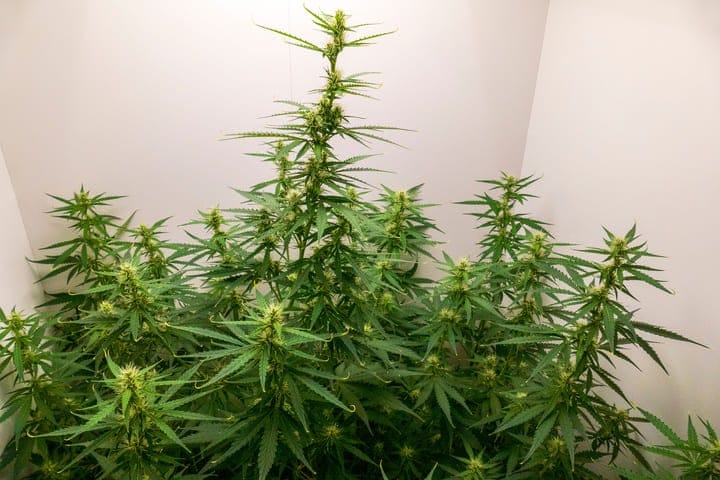
A tall cannabis plant can place its upper flowers much closer to the light while lower growth receives less illumination. It can also leave less room for air movement and make watering, inspection, and harvesting a great deal trickier.
Keeping plants shorter allows growers to make better use of horizontal space. Instead of one dominant central stem reaching upwards, the goal is often to create a broader, more evenly distributed canopy.
This isn't simply about making a cannabis plant look tidy. Cannabis architecture is influenced by genetics, environmental conditions and photoperiod. Research has shown that changing the light environment can alter plant morphology (essentially the shape and structure), while recent work has demonstrated that flowering itself is accompanied by substantial changes in branching and internode development [1] [2].
The trick is to work with those natural tendencies rather than constantly trying to correct them.
Start With The Right Genetics
The easiest way to achieve this is by ensuring plants can't grow particularly tall in the first place. One of the first things to consider when asking how to manage cannabis plant height is genetics. Cannabis varieties can differ substantially in their growth habits. Some naturally produce compact plants with relatively short internodes, while others are inclined to produce considerable vertical growth.
Flowering behaviour also varies genetically. Research into cannabis flowering genetics has identified significant variation between cultivars, including differences in flowering time and photoperiod sensitivity [3].
For growers working with limited vertical space, cultivar selection should therefore be a key part of the planning process.
Look for descriptions such as:
- Compact
- Short internodes
- Bushy growth
- Moderate stretch
- Suitable for limited space
It's worth remembering that a seed bank description is an indication rather than a guarantee. The final size of a plant depends on genetics, growing conditions, container size, light, and the length of the vegetative stage.
Autoflowering cannabis strains naturally make for good shorter plants, however, this can come with some trade-offs, namely a slightly lower yield potential and markedly less suitability for plant training. Low-stress training is absolutely fine with autoflowering plants, but techniques such as topping are less advisable as the shorter life cycle of an auto means less time for the plant to recover from stress. Bear these caveats in mind when selecting genetics.
Related Article:Should You Top Autoflowering Cannabis Plants?
Don't Give A Tall Plant Too Much Time To Get Taller
One of the simplest ways to control height is to consider when the plant will be allowed to flower. A cannabis plant doesn't necessarily stop growing vertically the moment flowering begins. Many photoperiod varieties experience a period of continued vegetative growth and stem elongation after the change in the light cycle. The amount of stretch varies considerably between genetics.
This is why a plant that looks perfectly manageable at the end of the vegetative stage can suddenly seem enormous a few weeks later, so mastering the stretch becomes crucial.
Research into cannabis flowering has shown that photoperiod can have a major influence on plant archtecture, including internode development and branching [1]. Genetics also play an important role in determining when plants transition towards flowering [3]
Use Low-Stress Training To Encourage Horizontal Growth
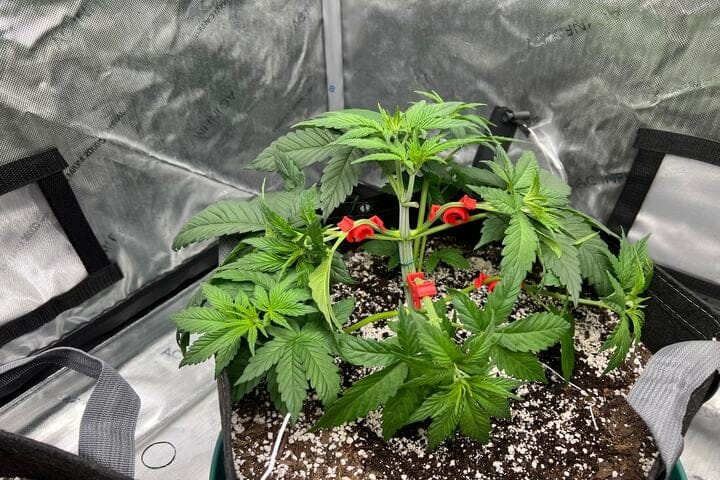
Low-stress training (LST) is one of the gentlest ways to influence cannabis plant shape. Rather than removing growing tips, LST involves carefully repositioning flexible stems so that the plant grows outward instead of concentrating all its growth vertically.
So how to manage cannabis plant height whie encouraging a shorter, wider plant? One answer is to guide the plant's branches horizontally rather than allowing one stem to dominate the canopy. This can expose a flatter, broader canopy and expose more developing growth to the available light.
The important word here is gentle. Stems can become surprisingly flexible during active growth, but they can also snap if bent too aggressively. LST should gradually guide growth rather than force a mature branch into an unnatural position.
Recent literature discussing cannabis training describes LST as a lower-trauma approach intended to alter plant architecture and improve canopy light exposure, in contrast with more aggressive forms of training [4].
For beginners, this makes LST a useful starting point when the main objectve is simply to keep a plant from beginning a single tall column.
Related Article:Introduction To Cannabis Plant Training Techniques
Topping Changes the Plant's Architecture
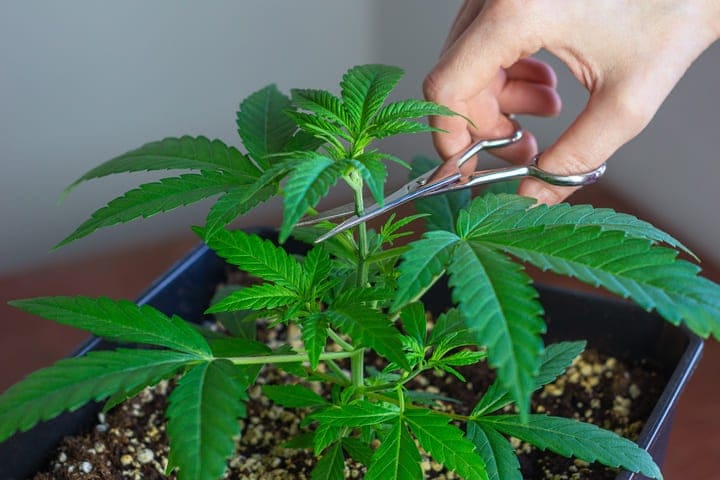
The acts of topping or fimming cannabis plants takes a more direct approach. Instead of bending the main stem, topping removes its growing tip. This disrupts the dominance of the main shoot and encourages lateral branches to become more prominent. Fimming, on the other hand, means cutting only 75-80% of the tip, creating several new bud sites.
The result can be a shorter, wider plant with several strong growing points instead of one central leader.
Related Article:The Difference Between Topping And Fimming
Research published in 2026 found that topping reduced plant height in two Cannabis sativa cultivars, although the response varied between cultivars and topping treatments [5]. That variation is important: cannabis doesn't respond identically to every training method, and results from one cultivar shouldn't automatically be treated as universal.
Topping is also more disruptive than LST. The plant needs time to respond and recover, so it isn't something to do repeatedly simply because a plant has become a little taller than expected. This is also why topping generally isn't recommended when growing autoflowers; the plant's shortened lifecycle simply doesn't allow adequate time for recovery and repair.
Good plant training is arguably about planning ahead rather than constantly correcting mistakes.
Supercropping and More Aggressive Training
There are more intensive techniques for manipulating cannabis architecture, including supercropping and various forms of repeated topping or manifolding. These approaches can produce very distinctive plant structures, but they aren't necessary simply because the grower wants to keep a plant short.
More aggressive training creates more opportunities for damaged stems and slowed growth. A recent review of cannabis training techniques distinguishes between lower-trauma LST and higher-stress approaches such as topping and supercropping [4].
For most growers dealing with a height problem, there's little reason to jump straight to the most aggressive techniques available. Start with genetics, plant timing, and gentle training. Escalate only if there is a genuine reason to do so.
The Importance of Light in Plant Height Management
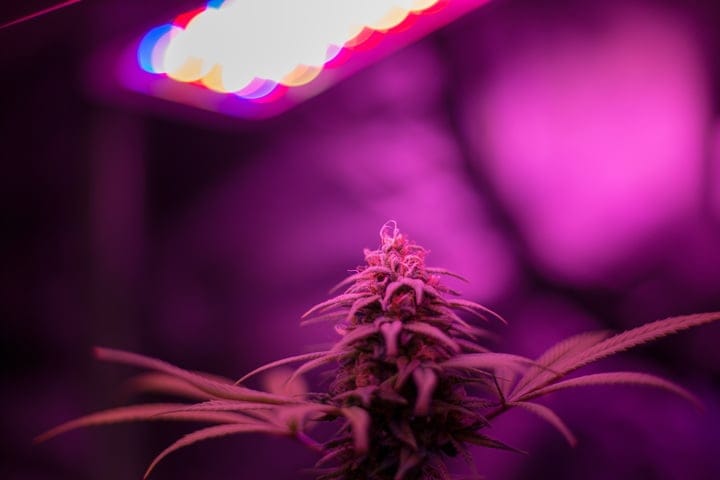
Plant height isn't controlled by training alone. The light environment can influence how cannabis grows. Research has demonstrated differences in plant morphology under different light spectra, including differences in plant height and other growth characteristics [6].
The plant's response to light is also influenced by intensity and photoperiod. In other words, there isn't one magic lighting setting that guarantees short plants.
For growers looking to manage cannabis plant height indoors, start by following the light manufacturer's recommended hanging height and intensity. This is preferable to placing the lights close to the canopy. Watch the plants as they grow and adjust the height accordingly to maintain an even, comfortable distance from the leaves.
Light distribution matters, too. A fixture positioned too high can encourage stretch, and one that's positioned too low can cause leaf stress and bleaching. Neither is useful when the aim is to build a compact, healthy canopy.
Understanding the relationships between light and plant structure is another important part of learning how to manage cannabis plant height successfully. The goal is to provide an appropriate environment rather than deliberately giving a plant poor conditions in an attempt to keep it small.
That's an important distinction.
There's a difference between controlling plant architecture and stressing a plant into growing poorly.
In practical terms, think about the finished plant, not just the plant in front of you.
Don't Use Stress As The Main Height Control Strategy
It can be tempting to think that restricting water, nutrients, or other resources will keep a cannabis plant small. Technically, stress can affect plant size. But smaller doesn't automatically mean better.
Recent research examining osmotic stress as a method of controlling cannabis plant height found that increased stress reduced plant height, but the effects on flower yield varied between cultivars and some treatments produced substantial yield reductions [7].
That's a useful reminder that the shortest possible plant isn't necessarily the goal.
A compact, healthy plant with a well-managed canopy is much more useful than a severely restricted plant that happens to be short.
Container Size Influences Plant Size, Too
The root environment also contributes to overall plant development. A plant growing in a small container has less available root volume than one with unrestricted space, but deliberately restricting roots isn't a shortcut to a productive compact plant.
Instead, think about container size as one part of the overall growing system. If vertical space is limited, it makes more sense to combine sensible container selection with appropriate genetics and training than to rely on root restriction alone.
How to Manage Cannabis Plant Height in a Small Space
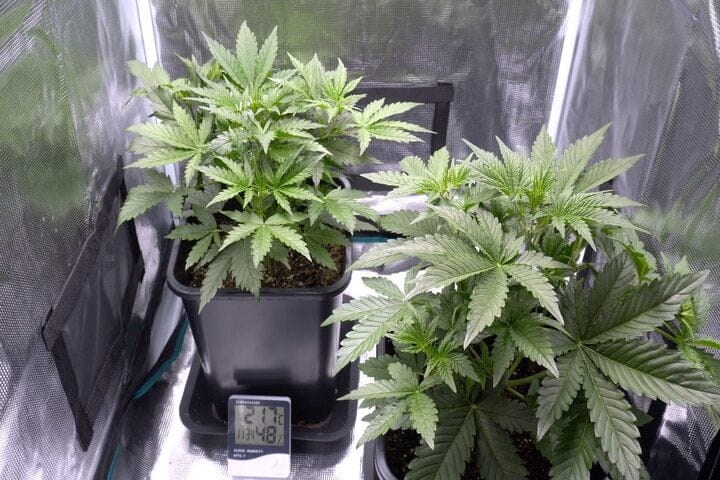
For anyone asking how to manage cannabis plant height in a limited space, the answer starts before the seed ever enters the growing medium.
Choose genetics that fit the available area. Think about the final height of the plant rather than its size during the early vegetative stage. Consider how much vertical clearance will be occupied by the container, lighting, and other equipment.
Training can then be used to make the most of the remaining space.
A compact plant with several evenly distributed branches can make better use of a small growing area than a tall plant with one dominant central stem. The objective isn't simply to make the plant shorter; it's to create a canopy that works with the environment you've provided.
Related Article:How To Grow Cannabis In A Small Space
How To Manage Cannabis Plant Height: The Bigger Picture
The best results often come from combining several relatively simple decisions:
- Choose genetics that fit the available space.
- Don't allow the vegetative stage to run indefinitely.
- Introduce gentle training while stems are flexible.
- Consider topping if you need a more fundamental change to the plant's structure.
Then pay attention to the environment.
Light, photoperiod, and genetics all contribute to plant architecture. Recent research has shown just how much variation exists between cannabis genotypes, so there is no single training techniques that will produce the same result on every plant [2] [3].
Most importantly, don't confuse intervention with good cultivation. A plant doesn't need to be topped, bent, pruned, and manipulated at every opportunity. Sometimes the best thing a grower can do is give a healthy plant the conditions it needs and leave it alone.
Learning how to manage cannabis plant height and keep plants short isn't about constantly cutting and stressing the plant. It starts with choosing the right genetics and using a little training to guide growth where you want it. Get those fundamentals right and keeping a cannabis plant compact becomes much easier.
How To Manage Cannabis Plant Height FAQs
How to Manage Cannabis Plant Height and Keep Plants Short?
Start with genetics suited to compact growth, then manage the plant's structure through appropriate timing and training. Low-stress training can encourage horizontal growth, while topping can create a shorter, wider structure by changing the plant's dominant growing point.
Can you keep a cannabis plant naturally short?
Yes. Genetics have a major influence on plant architecture, so choosing a naturally compact variety is one of the simplest ways to manage height. Training and environmental management can then be used to fine-tune the plant's shape.
Does topping make cannabis plants shorter?
Topping can reduce vertical dominance and encourage lateral growth, producing a shorter, broader structure. Research has demonstrated reductions in plant height following topping, although the response varies between cultivars.[5]
Is LST better than topping for keeping cannabis short?
Neither technique is universally better. LST is less disruptive and can gradually guide stems into a wider canopy, while topping makes a more significant change to the plant's growth structure. The best choice depends on the plant, available space and the grower's experience.
Does cannabis stretch after flowering starts?
Many photoperiod cannabis plants continue to elongate after flowering is initiated, although the amount of stretch varies between genetics and growing conditions. This is why it is useful to account for the plant's eventual size rather than waiting until it reaches the top of the growing space.
Can I keep an autoflowering cannabis plant short?
Autoflowering plants have a different flowering response from photoperiod-sensitive varieties, with flowering associated primarily with plant maturity rather than a change to the light cycle.[3] Their relatively fixed life cycle means that training decisions need to be made with recovery time in mind.
Does more stress make cannabis plants shorter?
Stress can reduce plant growth, but deliberately stressing a plant isn't a reliable way to produce a better compact crop. Research has found that attempts to reduce cannabis plant size through osmotic stress can also reduce flower yield, depending on the cultivar and treatment.[7]
What is the best way to grow cannabis in a small space?
Start with a cultivar suited to the available space, then use appropriate training and canopy management to control the plant's shape. Planning for the plant's mature size is much easier than trying to solve a height problem once the plant has outgrown its growing area.
------------------------------------------------------------------
References
[1] Spitzer-Rimon et al., 2024: Inflorescence development in female cannabis plants is mediated by photoperiod and gibberellin. https://pmc.ncbi.nlm.nih.gov/articles/PMC11560369/
[2] Lindholms et al., 2021: The Effect of Light Spectrum on the Morphology and Cannabinoid Content of Cannabis sativa L. https://pmc.ncbi.nlm.nih.gov/articles/PMC8489345/
[3] Comparative genomics of flowering behavior in Cannabis sativa, 2023. https://pmc.ncbi.nlm.nih.gov/articles/PMC10421669/
[4] The curious origins of a high-stress training technique mainlining: its molecular, biochemical, and agronomic perspectives for the cultivation of Cannabis sativa: 2025. https://pmc.ncbi.nlm.nih.gov/articles/PMC12771868/
[5] Morphological, physiological, and biochemical responses of two industrial hemp (Cannabis sativa L.) cultivars to different levels of topping, 2026.https://pmc.ncbi.nlm.nih.gov/articles/PMC13101382/
[6] Lindholms et al., 2021: Effect of Light Spectrum on the Morphology and Cannabinoid Content of Cannabis sativa L. https://pmc.ncbi.nlm.nih.gov/articles/PMC8489345/
[7] Crop steering through osmotic stress can reduce height but reduced yield in medical Cannabis, 2025. https://pmc.ncbi.nlm.nih.gov/articles/PMC12625080/
