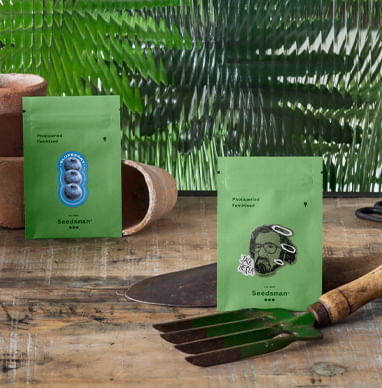
Seedsman CBG #1 is a photo-period strain which has been specially bred to produce very high levels of CBG (Cannabigerol), a cannabinoid which is usually present in low concentrations in typical cannabis samples.
CBG (cannabigerol) is the non-acid form of cannabigerolic acid (CBGA) which itself is the pre-cursor to the three main cannabinoid lines tetrahydrocannabinolic acid (THCA), cannabidiolic acid (CBDA), and cannabichromenic acid (CBCA). Through the action of UV light or heat enzymes in the cannabis plant break down CBGA and in the majority of strains it is converted into either THCA and CBDA. It logically follows that the higher the CBG the lower the THC and CBD levels and vice versa.
CBG is very interesting as it is thought to offer great medical potential. It lowers intra-ocular pressure thereby helping to treat cases of glaucoma. Early research reveals promise as an anti-bacterial, it inhibits colo-rectal cancer cells in mice, has been shown to protect neurons in mice with Huntingdon's Disease, it has also been shown to increase appetite in rats and it reduces inflammation in cases of Crohn's Disease.
Seedsman CBG#1 grows in all environments, indoors, outdoors and in a greenhouse. Its indoor flowering time is between 10 - 12 weeks with yields expected to be between 400 - 500gr/m2. Outdoors, northern hemisphere harvests will be ready towards the end of September - early October with each plant capable of producing up to 350 gr. Colourful displays of purple will affect some plants towards the end of flowering especially in the presence of cool night-time temperatures. Flavours are tangy, from the terpene limonene, with berry notes.
N.B. It is very important to germinate CBG #1 seeds at a constant temperature of 80° Fahrenheit (26-27° Celsius) for optimum viability. Avoid temperature swings and fluctuations.
CBG levels are 16.9% while THC is very low at 0.25%.
Cannabinoid content:
- THC - 0.25%
- CBD - 0.02%
- CBG - 16.9%
- CBC - 0.55%
- CBN - ND
- CBDA - 0.02%



.8e091a2b.svg)