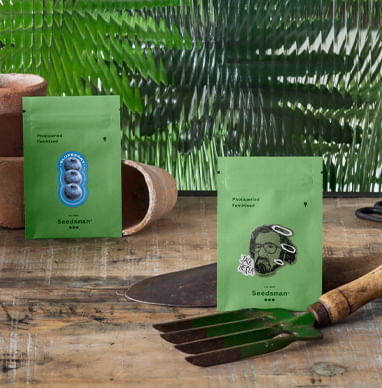
Purple Oreoz F1 is an easy to grow strain with indica-dominance. A cross of Purple Punch and Oreoz, Purple Oreoz F1 produces very chunky, resinous buds with great bag-appeal and tasty terps. helping to make extracts of great quality.
Purple Oreoz F1 is a vigorous strain, medium-sized but with high yields. Although it grows well indoors, taking 9 - 11 weeks to finish flowering, it is outdoors that this hash plant strain performs best, specifically in hot, warm, dry or humid climate conditions. The last type emphasises its high mould resistance. Harvests in the northern hemisphere are ready in September while southern harvests are ready in March. The mature buds are light green, silver and purple and are covered in resin-producing trichomes. This is an excellent strain for making solvent-free extracts and hashish.
The terpene profile is enticing with tropical fruit punch flavours having notes of pineapple and creamy fuel. Average THC content is about 24%, but can go higher, making this a highly potent, yet relaxing, strain.
What are F1 Cannabis Strains?
F1 cannabis seeds or plants are the first generation offspring of two parent plants. F1 hybrid seeds or strains are the first generation
offspring of two pure, distinct strains. Note that using two pure lines, the result of intensive inbreeding, is drastically different to simple cross-breeding.
F1 plants have been used for decades throughout the agricultural industry because they offer several advantages; hybrid vigour allows plants to grow bigger more quickly. Plants are more uniform, stable and offer greater resistance to plant pests and diseases. Yields are much higher too, an important consideration.
However, it should be noted that it is not recommended to allow F1 plants to breed for seed crops as the resulting F2 plants will be much less uniform, being less stable and having greater genetic variability. New F1 seeds will need to be purchased or a lengthy and complex F1 breeding project carried out to produce more seedstock.



.8e091a2b.svg)