

Walk into any grow room, dispensary, or online seed catalogue, and you’ll hear endless chatter about cannabinoids and terpenes. THC gets the headlines, CBD gets the wellness crowd, and terpenes get the connoisseurs waxing lyrical about mango notes and diesel funk. But beneath that noisy surface sits a quieter, equally fascinating family of compounds. Meet the flavonoids, the unsung supporting cast members of the plant kingdom. In cannabis, they may be far more important than most growers or consumers even realize. But what are flavonoids, and why are they so important in cannabis science?
What Are Flavonoids?
Flavonoids are a large family of plant secondary metabolites – natural compounds produced not for survival in the most basic sense, but for the plant’s ability to thrive, defend itself, and interact with its environment. They help protect the plant from stresses like drought, pathogens, UV light, and a whole lot more. In their structure, flavonoids share a characteristic C6-C3-C6 carbon skeleton, forming three-ring molecules that can be modified into dozens of subclasses such as flavones, flavonils, flavanones, anthocynanins (You may have seen this term if you’ve ever read up on purple cannabis strains) and more [1].

Put simply: if cannabinoids are the lead actors, flavonoids are key crew members – the cinematographers, lighting designers, and costume artists that shape the look, feel, and subtle emotional tone of the plant. They don’t get the recognition they deserve, but you’re well aware of what they do for the overall experience.
Across the plant kingdom, flavonoids play several crucial roles:
- Pigmentation: They give blueberries their deep purple, lemons their bright yellow, and autumn leaves their fiery reds. If you love all the colors in nature, tip your cap to flavonoids
- UV Protection: Plants use flavonoids like sunscreen, shielding delicate tissues from ultraviolet radiation.
- Defense: Many flavonoids deter pests, pathogens and environmental stressors.
You’ve encountered flavonoids many times, pehaps without actually realizing it. Quercetin in apples and onions, catechins in green tea, anthocyanins in berries – these are all flavonoids, and they’re all widely studied for their powerful antioxidant and anti-inflammatory properties. If you’re into wellness, you’ll already know that research consistently highlights the potential therapeutic value of flavonoids. Look at most of today’s healthy food choices and you’ll find a high presence of foods that are packed with flavonoids – their benefits are boundless.
What Are Flavonoids In Relation To Cannabis?
This is, after all, why you’re here. Cannabis contains its own unique set of flavonoids – some are common across the plant kingdom, and others are found almost exclusively in cannabis. Those have their own name, too. Cannabis-specific flavonoids are known as cannaflavins, and they’ve been attracting increasing scientific interest.
Recent research from Stellenbosch University uncovered a surprising diversity of flavonoids and related phenolic compounds in cannabis leaves, including rare molecules called flavoalkaloids, never before reported in cannabis [2]. This discovery underscored just how chemically complex the cannabis plant truly is.
Where Are Flavonoids Found In Cannabis?
Flavonoids are distributed throughout the cannabis plant, but concentrations vary:
- In the leaves: the leaves are often richer in flavonoids than the flowers
- Flowers: This is what you’ll experience. Flavonoids are still present in the buds, and they contribute to color, aroma nuance, and potential therapeutic effects.
- Stems and seeds: There are flavonoids present here, but at much lower concentrations.
While terpenes dominate the aromatic profile, flavonoids subtly influence the overall sensory experience, sometimes adding bitterness, sometimes contributing to color, and sometimes even modulating how aromas in the cannabis plant are perceived. It can be subtle, but it’s noticeable.
Why Do Flavonoids Matter For Cannabis Consumers?
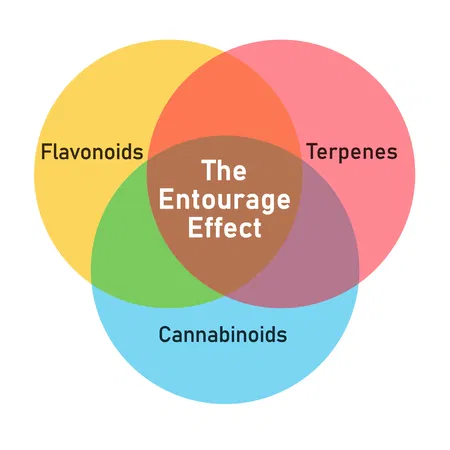
Experienced cannabis users will have heard of the entourage effect: the idea that cannabinoids and terpenes work synergistically. Flavonoids are increasingly recognized as part of this ensemble. They may influence how cannabinoids behave in the body, potentially or modulating therapeutic effects. For example, cannaflavin A has been studied for its anti-inflammatory potential, with some research suggesting it may inhibit inflammatory pathways more effectively than aspirin [3].
Color and Visual Appeal of Plants
Those deep purples, reds, and blues in certain cultivars? That’s often anthocyanins at work. While genetics and environmental temperature do play major roles in certain plant coloration, flavonoids are the pigments that bring the show to life.
Subtle Sensory Influence
It’s a long-held belief that terpenes alone are responsible for the flavor and aroma of cannabis, but that’s not strictly true – we're learning that it’s not just terpenes, but flavonoids, too. Flavonoids don’t dominate cannabis aroma to quite the same extent as terpenes, but they can influence:
- Bitterness
- Mouthfeel
- And some of the subtle notes of a strain’s flavor profile.
It helps to think of flavonoids more like background music – not always directly obvious, but essential to the overall mood of the piece nonetheless.
Potential Health Benefits
Although the research is very much still developing on how flavonoids influence cannabis, we do know that they’re associated with:
- Antioxidant activity
- Anti-inflammatory effects
- Neuroprotective potential
The Stellenbosch University findings highlight that cannabis contains a broader range of phenolic compounds than previously understood, potentially opening exciting new avenues for medical research.
Why Flavonoids Matter For Cannabis Cultivators
It’s not just useful to answer the question “what are flavonoids” from the perspective of a cannabis consumer. Growers can benefit from a better understanding of these natural compounds, too.
Some of the ways flavonoids can influence cannabis plant growth include:
Environmental Stress and Plant Health
Flavonoids help the plant cope with UV exposure, pests, and pathogens. For growers – especially in sunny climates like right here in South Africa – this means flavonoid production can be influenced by environmental conditions. Moderate UV exposure, for example, can stimulate flavonoid synthesis, much like a plant putting on a thicker layer of sunscreen.
Color Expression

Growers chasing those purples or reds as we’ve discussed should understand that flavonoid expression is influenced by :
- Genetics
- Temperature (cooler nights often enhance anthocyanin production)
- PH of the growing medium
- Nutrient availability
For cannabis growers, understanding flavonoids helps in manipulating environmental factors to coax out those stunning, highly desirable colors.
Potential Market Value
As cannabis consummers become better informed, strains rich in unique flavonoids – especially cannaflavins – may become more desirable. Just as terpene-rich cultivars command attention today, flavonoid-forward strains could become the next frontier.
Post-Harvest Handling
Something else to think about, as small a detail as it may seem, is that just like terpenes, flavonoids are sensitive to:
- Heat
- Light
- Oxidation
With this in mind, careful drying, curing, and storage are essential for weed growers looking to preserve these compounds. A grower who understands flavonoids treats their harvest like a winemaker treats grapes – protecting the delicate chemistry that defines the final product.
The Future of Flavonoid Research in Cannabis
The Stellenbosch University studies have opened a new chapter in cannabis science, revealing rare flavonoid-related compounds (flavoalkaloids) and highlighting the cannabis plant’s chemical complexity. This exciting new research suggests that cannabis may hold far more pharmacological potential than previously recognized.
As analytical technology improves, we’re likely to see deeper mapping of flavonoid profiles across cultivars, which in turn would lead to targeted breeding for specific flavonoid expressions. On the medical side of cannabis, research is exploring cannaflavins as anti-inflammatory agents, and from a consumer perspective, it could well follow that we’ll see new extraction methods designed to preserve flavonoids. In other words, after years in the supporting cast, flavonoids may be coming up for their time in the spotlight.
What Are Flavonoids, And Why Should You Care?
There’s something almost poetic about the way flavonoids operate. They’re not the loudest voice in the room, and they’re not the ones plastered across product labels, yet they quietly shape the cannabis experience is ways most people never notice. Asking what are flavonoids is a bit like asking who’s really responsible for the magic of a great film; you’re essentially talking about the invisible hands that make the visible world so much richer.
Cannabis is entering a new phase where nuance matters. Growers are no longer satisfied with “high THC” as a badge of honor by itself, and consumers are growing more experienced, more educated, and more discerning – more willing to explore the layers beneath the surface. What are flavonoids? They’re the new curiosity that sits right at that intersection where science meets craft, and where chemistry meets culture.
The more we understand these subtle compounds, the more we understand the plant itself. Not as a commodity, not as a trend, but as a living, evolving organism with layers of complexity still waiting to be uncovered.
--------------------------------------
References:
[1] Flavonoids: An Overview
[2] Comprehensive two-dimensional liquid chromatographic analysis of Cannabis phenolics and first evidence of flavoalkaloids in Cannabis
[3] Chemistry and Biological Activities of Cannflavins of the Cannabis Plant