
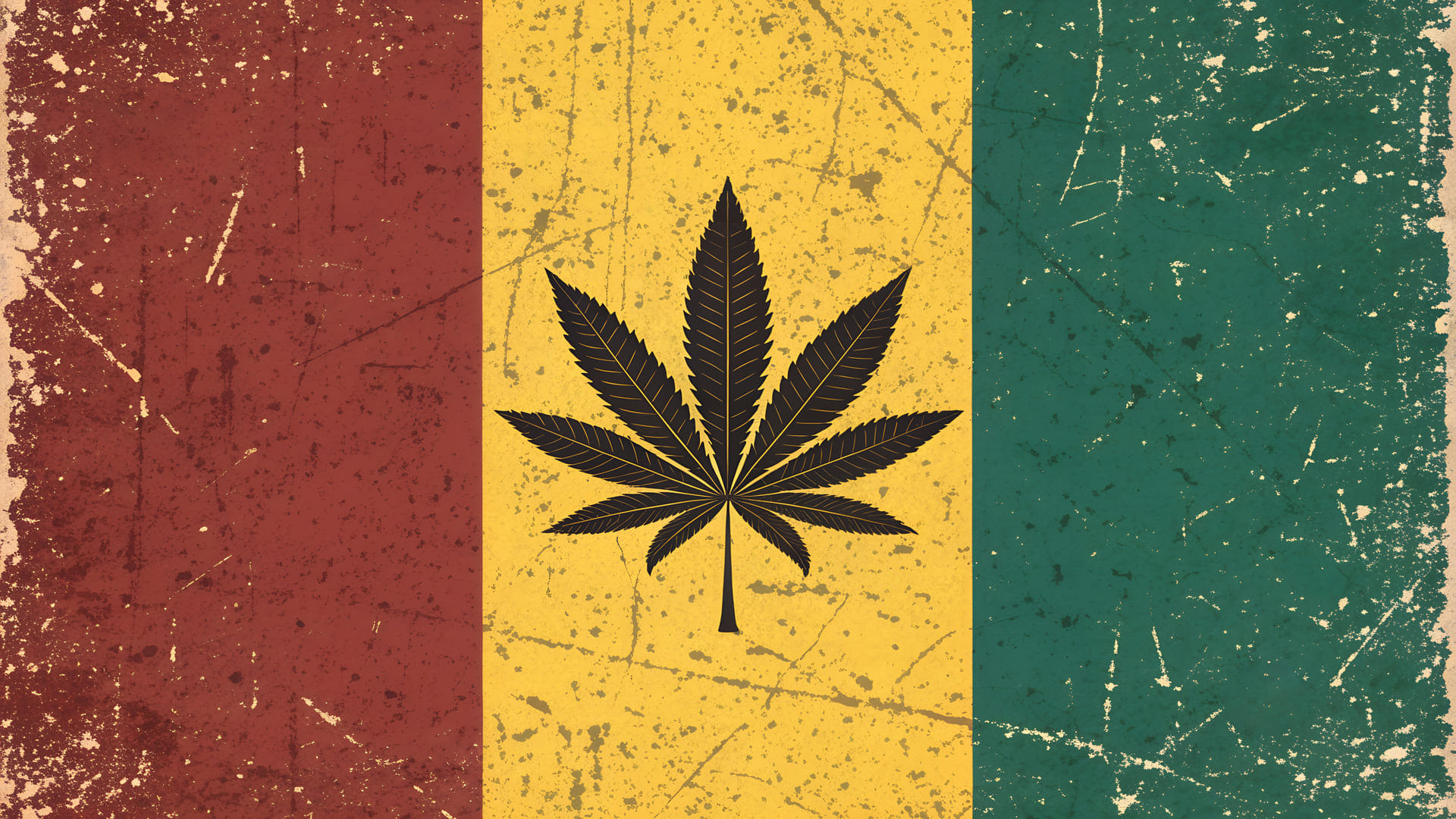

Despite being synonymous with Jamaican cannabis culture, the word ganja didn’t begin in Kingston – it started far earlier in Sanskrit, originating in the Indian subcontinent where the term and use first emerged. Originally “gañjã”, it referred to a powerful preparation made from the cannabis sativa plant. Over time, it travelled through Hindi and Urdu, taking on meaning for the buds or flowers of the plant.
As slang, ganja is one of the oldest terms in English for cannabis; Merriam-Webster records it in use by 1689. Compared to other weed names from around the world like “pot," “grass” or our favorite, “dagga”, ganja carries cultural weight and spiritual connotations, especially in reggae, Rastafari, and diaspora communities, reflecting the deep historical and cultural significance of the cannabis plant.
Ganja and Rastafarian Beliefs

Within Rastafarian culture, ganja is often referred to as the “holy herb” or sacrament. For Rastafarians, smoking ganja is more than recreational – it is a ritual, a way to commune with Jah, to meditate, to cleanse the mind, and to strengthen spiritual insight.
Rastafari gatherings often include use of ganja in ways somewhat analogous to communion in Christian practice. A pipe called the “chalice” is passed around; prayers or chants may precede its use. These acts are imbued with symbolism and respect – far from the stoner culture of the modern recreational cannabis user.
Resistance, Identity and Babylon

Ganja's Jamaican story begins no in the Carribbean, but with entangled histories in India. Between 1845 and 1917, over 36,000 indetured labourers were brought to Jamaica by the British Colonial government to work on sugar plantations after the abolition of slavery. Alongside their food, music, and spiritual traditions, they brought cannabis - and the Sanskrit word "ganja."
According to historian Isaac Campos (Home Grown: Marijuana and the Origins of Mexico's War on Drugs, 2012), Indian laborers used ganja both medicinally and ritually, practices that were soon adopted by Afro-Jamaican communities.. What started as a migrant tradition spread quickly, taking root in the fertile soil of Jamaica and fusing with African herbalism and folk spirituality.
By the early 20th century, ganja had already become a common part of Jamaican working-class life. But it was with the rise of Rastafari in the 1930s and 40s that ganja was elevated from plant to sacrament. Leonard Howell, often called the "first Rasta," founded the Pinnacle community in 1940 in St. Catherine. Ganja was cultivated there not just as a crop, but as a sacred herb - a gateway to higher reasoning and communion with Jah. For many, ganja was more than smoke - it was resistance against Babylon. The notion of “Babylon” in Rastafari refers to oppressive systems – colonial, legal, racial – and many songs and rituals use ganja as a tool to symbolically, spiritually, or physically resist Babylon.
Further Reading: Jamaica: Cannabis And Rastafari
Criminalization of Ganja
Ironically, just as ganja became embedded in Jamaican culture, colonial authorities moved to outlaw it. The Dangerous Drugs Act of 1913 criminalized possession and cultivation. After Jamaica's independence in 1962, these laws remained - and were enforced harshly. Journalist George Davis noted that between 1962 and 1972, more than 100,000 Jamaicans were prosecuted for ganja possession, and over 14,000 acquired criminal records in the first decade of independence (Jamica Gleaner, 2018).
Unsuprisingly, the policing was unequal: Rastafarians and rural farmers were disproportionately targeted, reinforcing ganja as both a tool of oppression and a symbol of defiance.
Legal Reform
The tide began to turn in the 21st century. In 2015, Jamaica decriminalized possession of up to two ounces of ganja, allowed households to grow up to five plants, and formally recognized Rastafarian religious use. The country also established a framework for a medical cannabis industry, reflecting the evolving legal status of ganja in Jamaica. As part of this framework, medical cannabis dispensaries were established and regulated to provide access for patients using cannabis for medical purposes. While religious and medical uses are recognized, recreational purposes remain treated differently under the law, with stricter regulations and limitations.
Still, challenges remain. Small farmers who preserved ganja through decades of prohibition often struggle to compete with licensed corporations. Critics argue that without protection, the traditional ganja economy risks being sidelined in favor of export markets and corporate profits.
Ganja’s Place In Music and Culture

If you want to trace the path of ganja through popular culture, look to reggae and dancehall music scenes. Ganja is everywhere in the lyrics, the imagery, and the grooves.
Reggae & Roots
Bob Marley is probably the first name most people think of when it comes to music and ganja. Songs like Kaya evoke images of smoke-filled peace and the sacred herb. Ganja is central in many Marley songs, not just as a recreational tool but as spiritual balm. It’s no coincidence that Bob is the most iconic and enduring cultural symbol of ganja, with his face adorning pro-weed merchandise the world over to this day.
Peter Tosh is more explicit. His anthem “Legalize It” directly calls for the legal acceptance of ganja, mixing protest, spiritual consciousness, and cultural identity.
Other reggae artists like Barrington Levy, Lee “Scratch” Perry, and U-Roy have often sung about “herb”, “sensi” or ganja, tying it to calls for freedom, love, roots, and connection.
How the Cannabis Sativa Plant Is Grown In Jamaica

Jamaican ganja is deeply tied to the land. Traditional cultivation takes place in remote hillsides of parishes like St. Ann, St. Elizabeth, Portland and Trelawny. Farmers often rely on ancestral knowledge: selecting seeds from the strongest plants, rotating plots, and using natural fertilizers. The cannabis sativa plant is the primary species grown, and farmers cultivate different strains to achieve desired effects and adapt to local conditions.
Most Jamaican strains are sativa-dominant landraces. These plants grow tall, with narrow leaves and airy buds, adapted to Jamaica’s tropical climate. The dried flowers from these plants are the primary form used for consumption. The effects are typically described as uplifting, energetic, and spiritual – ideal for both long workdays and deep reasoning sessions.
In their landmark study Ganja in Jamaica (1975), anthropologists Vera Rubin and Lambros Comitas found that rural laborers often used ganja tea or smoke before work, claiming it gave stamina, reduced fatigue, and relieved aches. Ganja is commonly consumed as tea or smoked, and these methods are part of a broader tradition of using cannabis products derived from the cannabis sativa plant. The inhalation of cannabis smoke plays a significant role in traditional use. Consuming cannabis in various forms, including edibles and infusions, is widespread among rural communities. They concluded:
"Ganja is a fact of life in Jamaica….it permeates almost every aspect of existence.”
Popular Jamaican Ganja and Different Strains
If you want a single ganja strain name to make people nod knowingly, it’s Lamb’s Bread (often spelled Lamb’s Breath or Lambsbread). Lamb’s Bread is storied: widely promoted as a Jamaican landrace sativa linked in popular lore to Bob Marley, and celebrated for its uplifting, creative high. Modern cannabis databases and strain guides treat Lamb’s Bread as a classic Jamaican sativa with distinct, citrusy, spicy notes and an energetic effect profile.
It’s worth flagging two caveats. First, strain names circulate in informal markets and can be applied loosely; the Lamb’s Bread sold internationally may not be genetically identical to the old hillside Jamaican landrace recalled in people’s memories. Second, modern commercialization and crossbreeding mean that many varieties labelled “Jamaican” are hybrids that mix other genetics. Still, the cultural capital of names like Lamb’s Bread is enormous; they act as a bridge between the farmer in the Blue Mountains and the listener in Pretoria who drops the name in a playlist.
Other historically notable Jamaican types include various “sensi” or “collie” landraces, and in earlier decades the island’s exports included plants that abroad were grouped with names like “Panama Red” or “Jamaican Gold” depending on source. Today, the market is more fragmented; seed companies sell named cultivars while small growers will value seed-saving and regional phenotypes. This makes true Jamaican seeds a bit harder to come by. Strains like Jamaican Pearl and King’s Bread are still celebrated as the best of Jamaican, and Bob even has a strain named after him – Marley’s Collie, from Sensi Seeds.
Conclusion: More than Smoke
The story of ganja is a story of journeys: From India to the Caribbean, from crimialization to cultural sanctification, from hillside fields to globals tages. It is a tale of roots and resistance, of music and meditation, of a people who turned a plant into a symbol of identity.
Today, whether smoked in a Kingston Yard, sipped as tea in rural parishes, or sung about on stages across the world, ganja remains central to Jamaican life.
As Bob himself once said: