
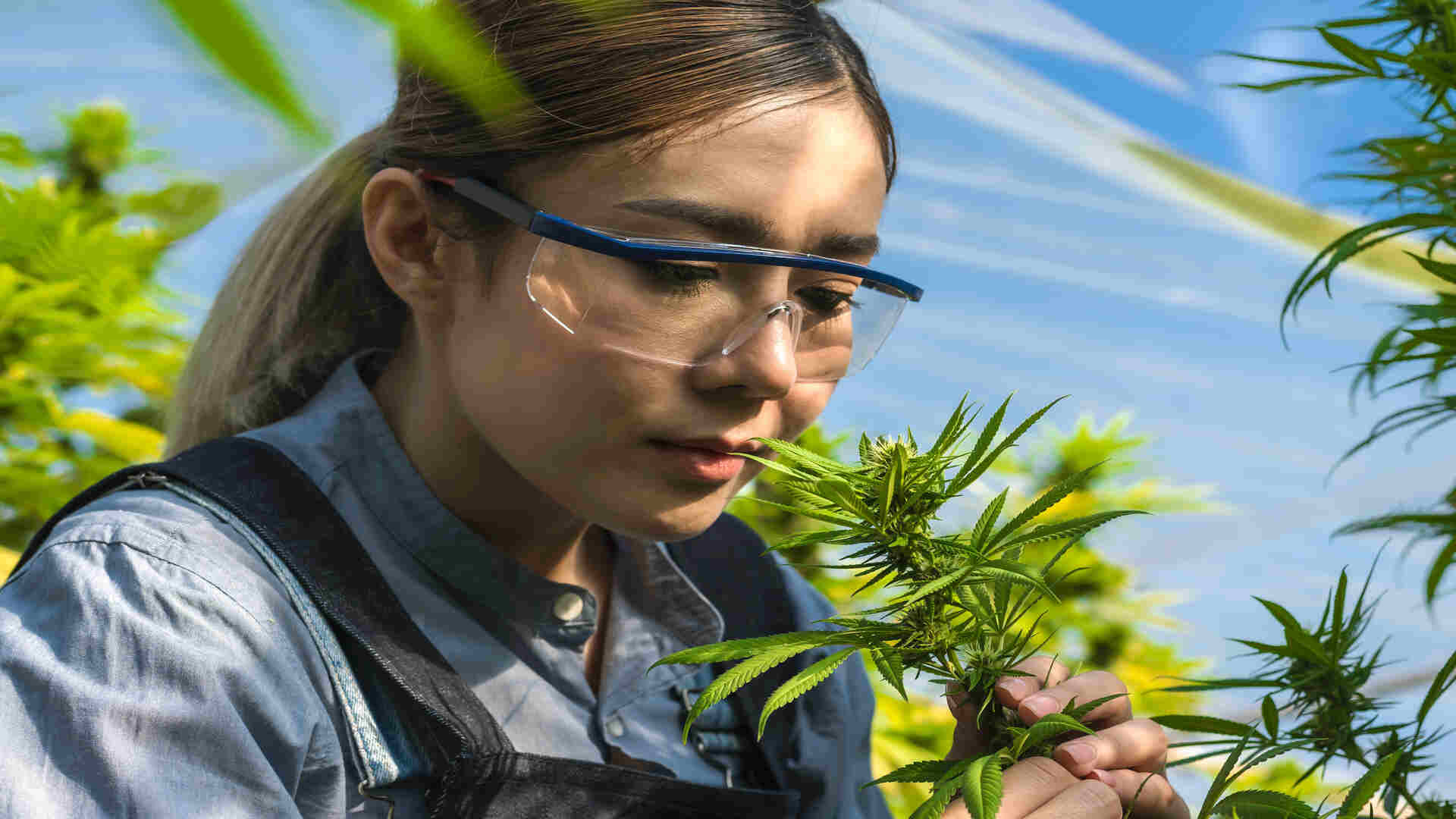

There are few plants as immediately recognisable by smell as cannabis. Walk past a flowering plant and you might get citrus, pine, pepper, earth, fuel, or something considerably harder to describe. Some cultivars have an almost sweet, tropical character. Others are famously pungent, with sharp, cheese or skunky notes.
But what actually creates that cannabis smell?
For years, the simple answer has been "terpenes". There's certainly some truth in that, but the science is more interesting than the usual explanation suggests. Cannabis smell comes from a remarkably complicated mixture of volatile compounds, with terpenes playing an important role alongside several other chemical families. [1]
Key Takeaways:
- Cannabis aroma comes from a complex mixture of volatile compounds, not terpenes alone.
- Terpenes make an important contribution to the characteristic smell of cannabis
- Genetics have a major influence on terpene and volatile-compound production
- Very small quantities of some non-terpenoid comounds can have a major effect on aroma
- Cannabis aroma can change during plant develiopment
- Cultvation and post-harvest conditions can influence the aromatic profile of cannabis flowers
- A strong cannabis smell does not necesssarily mean higher THC
What Causes The Distinct Cannabis Smell?
Cannabis flowers contain a complex mixture of volatile organic compounds. These are substances that readily evaporate into the air, allowing them to reach the nose and contribute to what we experience as aroma. When answering the question "why does cannabis smell so strong?" we first must look at the nuances that create these aromas.
Terpenes are mong the most important of these compounds. They are produced by many plants across the natural world and are responsible for many familiar aromas, from the citrus character of certain fruits to the scent of pine needles and herbs.
Related Article: What Are Terpenes And How Do Cannabis Plants Produce Them?

Cannabis produces a diverse collection of terpenes, including myrcene, limonene, pinene, beta-caryohphyllene, and more. Different cultivars can contain these compounds in very different proportions, helping to create distinct chemical profiles. [1],[2]
But there's an important qualification. It's not just terpenes that give cannabis its aroma and flavour.
Research has identified other volatile compounds in cannabis, including esters, aldehydes, ketones, and sulphur-containing compounds. Why does cannabis smell so strong? For one it's because some of these compounds can have a surprisingly powerful influence on aroma despite occurring in very small quantities. [1]
That helps explain why simply looking at a list of the major terpenes doesn't always tell you exactly what a flower will smell like.
Why Do Different Cultivars Smell Different?
Genetics are a major part of the answer. Cannabis has genes that control enzymes involved in producing terpenes and other aromatic compounds. Different genetic backgrounds can therefore produce different chemical profiles. Research has found substantial variation in terpene composition between cannabis cultivars, while differences in terpene-synthase genes help explain some of that variation. [2][3]
The picture becomes even more interesting when we look at the plants themselves. Research has found that plants carrying the same cultivar designation can still show meaningful chemical variation. [3]
This is one reason cultivar names alone don't provide a complete description of aroma.
The chemistry can also be more complicated than a simple "dominant terpene" label suggests. Compounds present at relatively low concentrations can make a disproprotionately large contribution to the overall aroma, depending on their odour threshold and how they interact with other volatile compounds. [4]
In other words, cannabis aroma is less like a single ingredient and more like a recipe.
Where Are Aromatic Compounds Produced In Cannabis Plants?
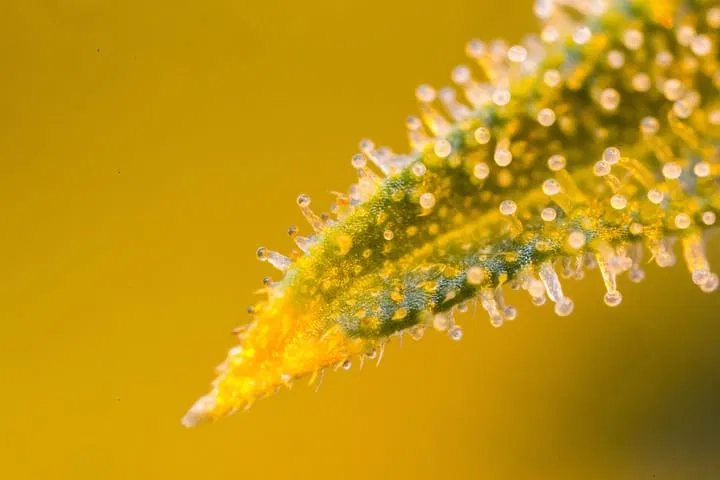
Much of the cannabis plant's specialised chemistry in associated with its glandular trichomes. Those tiny structures are particularly abundant on female cannabis flowers. They accumulate cannabinoids and other specialised metabolites, including many of the compounds involved in cannabis aroma. [5]
Trichome development changes as the plant develops, and the chemical profile of the flowers changes alongside it. Research following cannabis plants through their development has found different patterns for different terpene groups and chemotypes rather than one universal progression. [6]
That matters because it means the aroma of a flowering plant isn't fixed.
The combination of compounds present in the flowers can change as they develop, helping to explain why the smell of a plant can become noticeably different as it approaches maturity.
Related Article:Cannabis Trichomes 101
Why Does Cannabis Smell Fruity, Gassy, Earthy, or Skunky?
This is the part where things get particularly interesting. Aroma is produced by the combines effect of many compounds rather than one chemical acting alone. Different combinations of and concentration can create very different sensory impressions. [4]
Limonene, for example, is associated with citrus aromas in many plants. Pinene can contribute pine-like notes, while compounds such as ß-caryophyllene and humulene are associated with woody, spicy, or earthy characteristics.
But cannabis can also produce aromas that aren't adequately explained by those familiar terpene names.
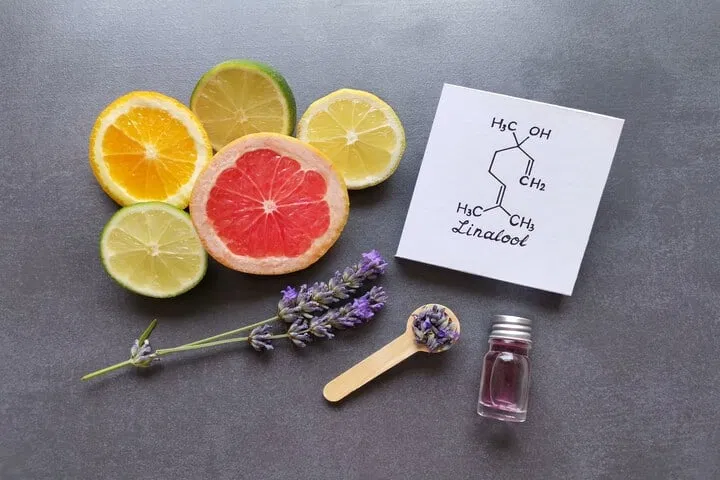
Researchers have identified minor non-terpenoid volatile compounds that correlate strongly with some of the distinctive sweet and savoury aromas found between cannabis varieties. In one study, volatile sulphur compounds and skatole were particularly important to certain aromatic profiles. [4].
The famous skunky character is another good example. Researchers identified a family of volatile sulphur compounds including 3-methyl-2-butene-1-thiol as important contributors to the characteristic skunk-like smell of cannabis. [7]
These compounds can occur at extremely low concentrations while stil having a strong sensory impact. So when someone describes a cultivar as "gassy", "skunky" or unusually pungent, the explanation may involveconsiderably more chemistry than the terpene label suggests.
Related Article:The Best Cannabis Strains For Terpene Lovers in 2026
Does The Environment Affect Cannabis Aroma?
Genetiics provide much of the plant's chemical potential, but they aren't the only factor. Current research indicates that cultivation practices and environmental conditions can influence the synthesis and accumulation of volatile compounds in cannabis. Post-harvest handling can then alter that chemical profile further. [1]
There isn't a simple recipe for producing a particular smell; cannabis chemistry is too complex for that. Instead, it's more useful to think of aromas as the result of several interacting factors: genetics, plant development, growing conditions, and what happens to the flowers after harvest. [1][6]
That helps explain why two plants with closely related genetics don't necessarily smell identical.
What Happens To Cannabis Aroma After Harvest?

Harvest isn't the end of the story. The aroma isn't locked in once the buds are stripped from the plant. Drying, curing, and storage can alter the volatile profile of cannabis flowers. Because many aroma compounds are volatile, some can be lost or changed during post-harvest processing. [1][8]
Research comparing different drying approaches has demonstrated measurable differences in the retention of volatile compounds. Other research has found that storage conditions can also influence the overall volatile profile. [8][9]
One study, for example, found that freeze-drying preserved cannabinoid content well but resulted in a loss of volatile compounds responsible for cannabis aroma. The same research found differences in volatile-compound retention between storage conditions. [8]
That helps explain something many growers notice: freshly harvested plant material doesn't necessarily smell the same as properly dried and stored flower. The chemistry is changing.
It also explains why post-harvest handling deserves more attention that it sometimes gets. If volatile compounds are lost or altered during drying and storage, some of the characteristics that made a particular cultivar interesting can change along the way.
Does A Strong Smell Mean Stronger Cannabis?
Not necessarily. Aroma and cannabinoid concentration are different aspects of cannabis chemistry, and a particularly pungent cannabis smell shouldn't be treated as a reliable indicator of THC contentration.
The same applies in reverse. A flower with a relatively subtle aroma isn't automatically low in cannabinoids. Aroma can tell us somthing about the plant's volatile chemistry, but it isn't a simple potency meter.
Cannabis Aroma FAQ
What causes the smell of cannabis?
Cannabis smell comes from a complex mixture of volatile compounds. Terpenes are important contributors, but other compounds, including esters, aldehydes, ketones and sulphur-containing molecules, can also influence aroma.
Which terpenes are found in cannabis?
All though there too many to list here, some of the more common cannabis terpenes include myrcene, limonene, pinene, β-caryophyllene, humulene, linalool and terpinolene. The exact profile varies between cultivars and individual plants.
Why does some cannabis smell like fuel?
Fuel-like or "gassy" aromas can result from combinations of volatile compounds. Cannabis aroma is chemically complex, so a single terpene doesn't necessarily explain the complete smell.
Why does cannabis smell skunky?
Some of the characteristic skunky aroma is associated with volatile sulphur compounds. Research has identified 3-methyl-2-butene-1-thiol and related compounds as important contributors to the characteristic skunk-like aroma of cannabis.
Why does cannabis smell different as it flowers?
The concentrations of cannabinoids and terpenes change during plant development, and different groups of compounds can follow different patterns. This means the chemical profile, and therefore potentially the aroma, can change as the flowers develop.
Does drying change the smell of cannabis?
Yes. Drying can affect the concentration and composition of volatile compounds, which can alter the resulting aroma. Research has found differences in volatile-compound retention between drying methods.
Does a stronger-smelling cannabis plant contain more THC?
Not necessarily. Aroma and cannabinoid concentration are separate aspects of cannabis chemistry, so smell alone cannot reliably predict THC content.
--------------------------------
References
[1] Exploring Aroma and Flavor Diversity in Cannabis sativa L. 2025: https://pubmed.ncbi.nlm.nih.gov/40649299/
[2] Terpene Synthases and Terpene Variation in Cannabis sativa, 2020: https://pubmed.ncbi.nlm.nih.gov/32591428/
[3] Characterization of Chemotype-Dependent Terpenoids Profile in Cannabis, 2021: https://pubmed.ncbi.nlm.nih.gov/34650264/
[4] Minor, Nonterpenoid Volatile Compounds Drive the Aroma Differences of Exotic Cannabis, 2023: https://pubmed.ncbi.nlm.nih.gov/37901519/
[5] Architecture and Florogenesis in Female Cannabis sativa Plants, 2019: https://pubmed.ncbi.nlm.nih.gov/31001293/
[6] Evolution of the Cannabinoid and Terpene Content during the Growth of Cannabis sativa Plants from Different Chemotypes, 2016: https://pubmed.ncbi.nlm.nih.gov/26836472/
[7] Identification of a New Family of Prenylated Volatile Sulfur Compounds in Cannabis Revealed by Comprehensive Two-Dimensional Gas Chromatography, 2021: https://pubmed.ncbi.nlm.nih.gov/34869990/
[8] The Influence of Drying and Storage Conditions on the Volatilome and Cannabinoid Content of Cannabis sativa L. Inflorescences, 2024: https://pubmed.ncbi.nlm.nih.gov/38702447/
[9] In Pursuit of Optimal Quality: Cultivar-Specific Drying Approaches for Medicinal Cannabis, 2024: https://pubmed.ncbi.nlm.nih.gov/38611577/