

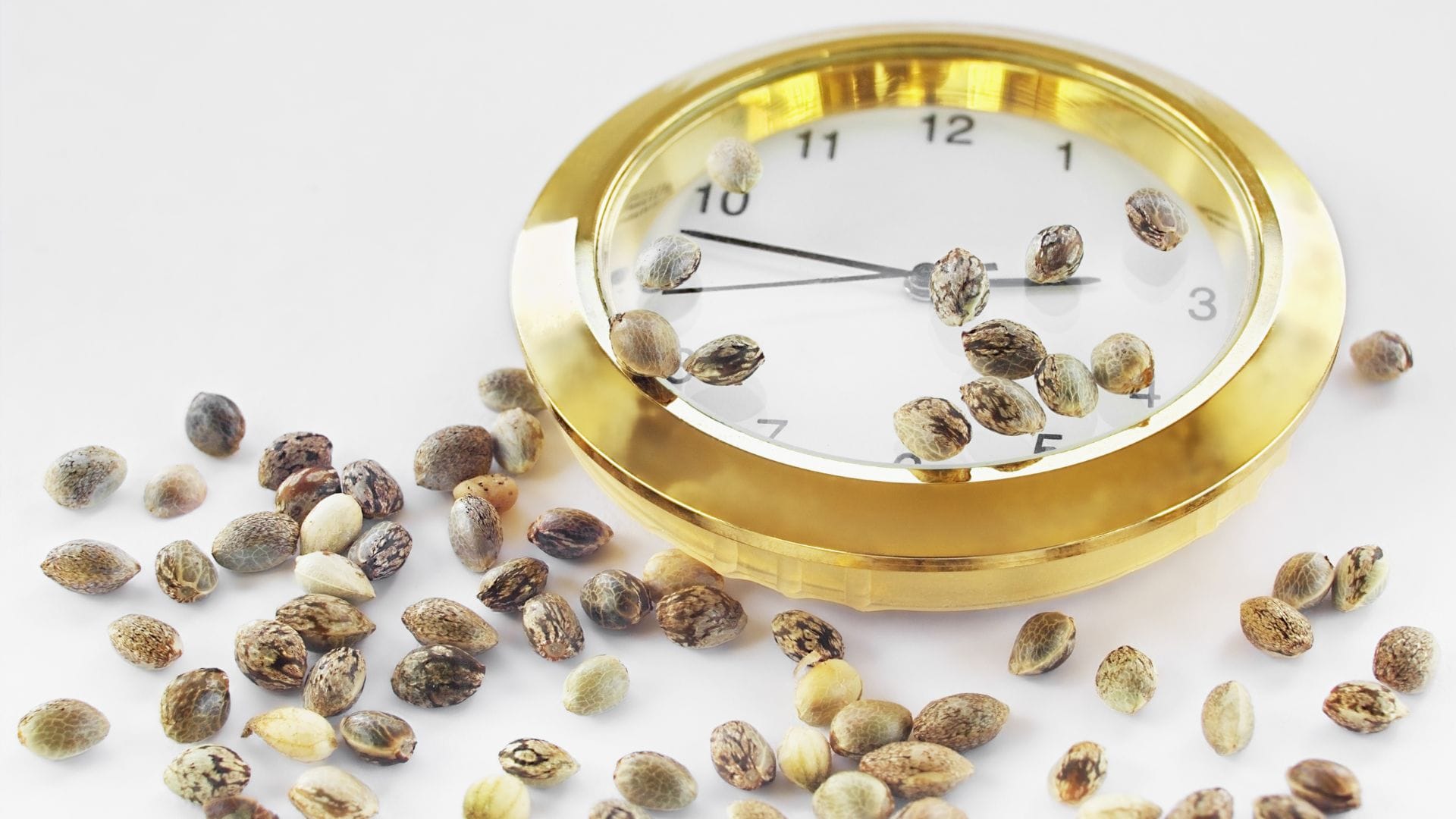
Like most organisms, cannabis plants can tell the time. They can observe cues and generate signals for timekeeping to know at what stage in the day, season and year they are. Read more below to learn how this works and how to manipulate it for greater gains!
By now it's common knowlege that the Earth rotates on its axis, completing one rotation every 24 hours. This creates a regular cycle of light and dark periods, significantly impacting any life that evolved on the planet. Through billions of years of evolution, organisms have developed internal mechanisms to sense and respond to the day and night cycles. This ability is particularly important for organisms that rely on photosynthesis for primary production. By regulating their internal processes and responses to external conditions, organisms can pre-empt changes in the day/night cycles, which is crucial for growth, metabolism, signalling, and behaviour.
Interestingly, humans also have a circadian rhythm that governs our sleep-wake cycles. This rhythm changes as we age, with the teenage years being a particularly notable adjustment period. Hormone production during this time tends to shift our internal clocks towards staying up later at night and waking up later in the day. This can explain the commonly observed phenomenon of teenagers sleeping in late. (Crowley et al. 2007)[1].
Plants' Internal Clocks
Plants have their own internal timing mechanisms, known as circadian clocks, that are highly sensitive to external factors like sunlight and temperature. This means that if a plant were to travel from New York to London, it would experience a type of jet lag similar to that experienced by humans. Interestingly, plants can recover from changes to their day/night cycles much more quickly than mammals, meaning that if you and your plant were to take this trip together, the plant would bounce back from the jet lag much faster than you would. As far back as 1729, scientists have observed the rhythmic movement of leaves. Charles and Francis Darwin published their own research on the subject over 150 years later, in 1880.

What Is The Circadian Clock?
The circadian clock is an internal system that governs various life-sustaining processes by responding to external signals in plants. These external cues are primarily light and temperature, which the plant detects using photoreceptors. To synchronize the internal mechanisms with the external stimuli, regulatory proteins called transcription factors play a crucial role. These proteins control the expression of genes by activating and repressing them, ensuring that the plant's transcriptome is optimally arranged to function according to the light/dark cycles.
Many genes exhibit a cyclic pattern of expression, with more than 6% of Arabidopsis thaliana genes following a circadian pattern. However, more than a third of the total genes expressed are influenced by circadian-regulated genes. The circadian clock also involves multiple feedback loops, which work together to activate and repress gene expression in a well-coordinated manner. In plants, the first circadian gene identified was TOC1, which is a repressor of transcription. When TOC1 loses its function due to mutation, plants have shorter days than normal plants. Another gene called TIC may also play a role in circadian regulation, but its exact function is still under debate. These complex mechanisms reveal just one aspect of the circadian clock.
How Does Gene Expression Result In Timekeeping?
The mechanisms of the circadian clock rely on the production and breakdown of specific components that fluctuate throughout the day and night, allowing organisms to perceive time. For instance, if light triggers the creation of protein B, it will accumulate during the day and then degrade during the night. Assuming that the rate of synthesis and breakdown is equivalent, if the concentration of protein B has reached its lowest point at the beginning of the next day, the organism knows that the night was longer than the day.
This system is also used in flower initiation and seasonal recognition. However, this is a simplified explanation, as the process is much more complex. For a detailed understanding, refer to Lee et al. (2019), which provides an extensive explanation of the degradation of the ZTL clock component and the light-dark transition[2].
How To Use Light To Boost Yield
When cultivating cannabis indoors, the standard photoperiods are typically 18 hours of light followed by 6 hours of dark during the vegetative stage and 12 hours of light followed by 12 hours of darkness during the flowering stage. However, some anecdotal evidence suggests that not all cultivars are optimized for these standard photoperiods, and some breeders have provided examples of cultivars with different flowering light periods. In an article by horticulturist and commercial cannabis grower Stewart Maxwell, an alternative light regime is suggested. After initial flower induction at 12:12 for 6-8 days, most cultivars can supposedly continue to flower at 13.5:10.5 light: dark for the next 5 weeks before returning to 12:12 for the finishing weeks. According to Maxwell, this can increase the plant's photosynthetic potential and lead to a higher yield. However, cultivators should be cautious and mindful that genetics play a significant role in the outcome of cultivation. Changes to the photoperiod or dark period may result in stress and hermaphroditism. As such, any experimentation should be thoroughly planned and executed strictly without deviation to minimize the risk of failure.
_________________________
References:


