

The idea that hemp was always so low in THC is a recent political construct by man. The accurate way to describe how hemp is different from cannabis would be to say that hemp is the term used to describe the non-narcotic use of the cannabis plant. All other attempts run into contradictory anomalies that show them to be unsuitable descriptors.
Traditional Cannabis
Wild-type cannabis typically contains levels of THC over 0.1%. Only c.ruderalis and c. sativa subsp. spontanea have CBD present in every sample tested so far. In the 1990’s hempseed oils could be found with more than 1mg of THC per 1ml of seed oil. Since then, man has focused on reducing the THC content found naturally in cannabis varieties grown for industrial use. A study in Serbia comparing wild-type hemp plants with EU industrial hemp cultivars and a US CBD production cultivar, found that overall the essential oil from wild-type plants was significantly different in chemical profile and bioactivity compared to registered hemp cultivars. Wild-type hemp plants consistently had higher levels of THC than registered varieties, a greater antimicrobial activity against Staphylococcus susp. aureus, Enterococcus faecalis, and G−Yersinia enterocolitica, Salmonella enterica subsp. enterica, and yeasts Candida albicans and Candida tropicalis, and one select phenotype even producing higher levels of CBD in its essential oil than that of the US CBD production cultivar.
2% THC Hemp
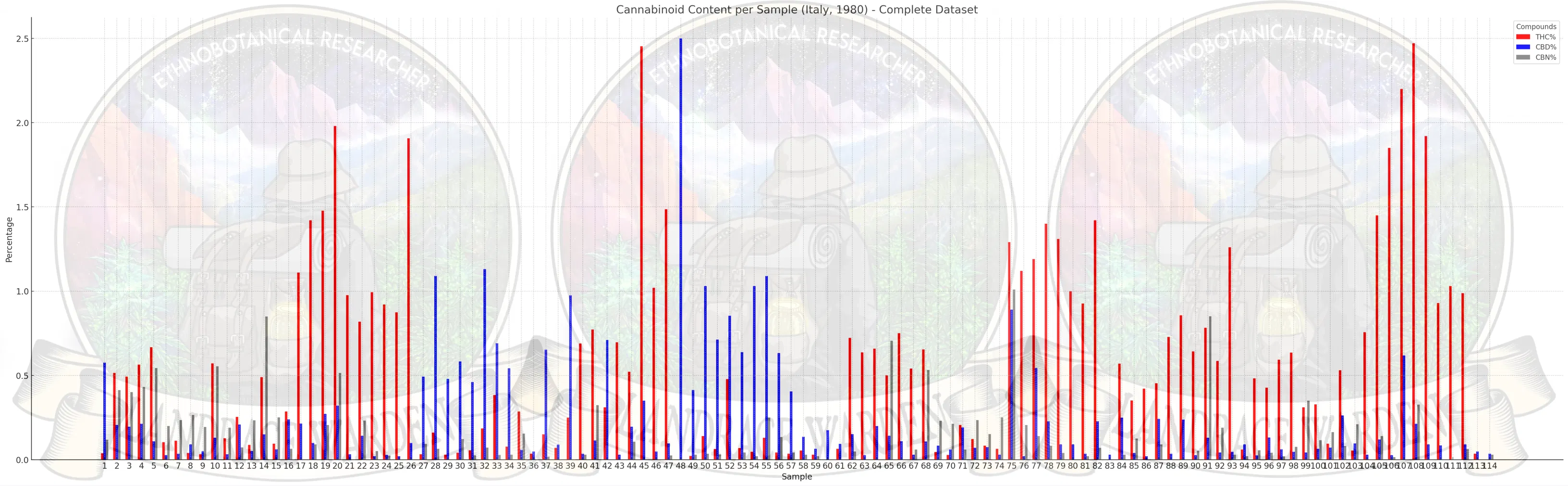
The development and applications of molecular markers to hemp breeding are less than 30 years old. In the 1990’s, traditional Italian hemp fibre variety ‘Eletta Campana’ was unable to remain as a hemp variety in the EU at the time due to its THC content, as a few phenos contained more than 2% THC and many were THC dominant. The interesting context is that in the 1979, of 114 seized samples of illegal cannabis in Tuscany Italy, only 3 out of 114 analysed contained more than 2% THC, with the highest concentration of 2.47% recorded. So much of the illegal cannabis being used in Italy in the late 1970’s was of the same potency that could be found naturally in traditional hemp fibre varieties of the region in the 1990’s. 3 out of 10 of the seized samples from 1979 contained less than 0.3% THC.

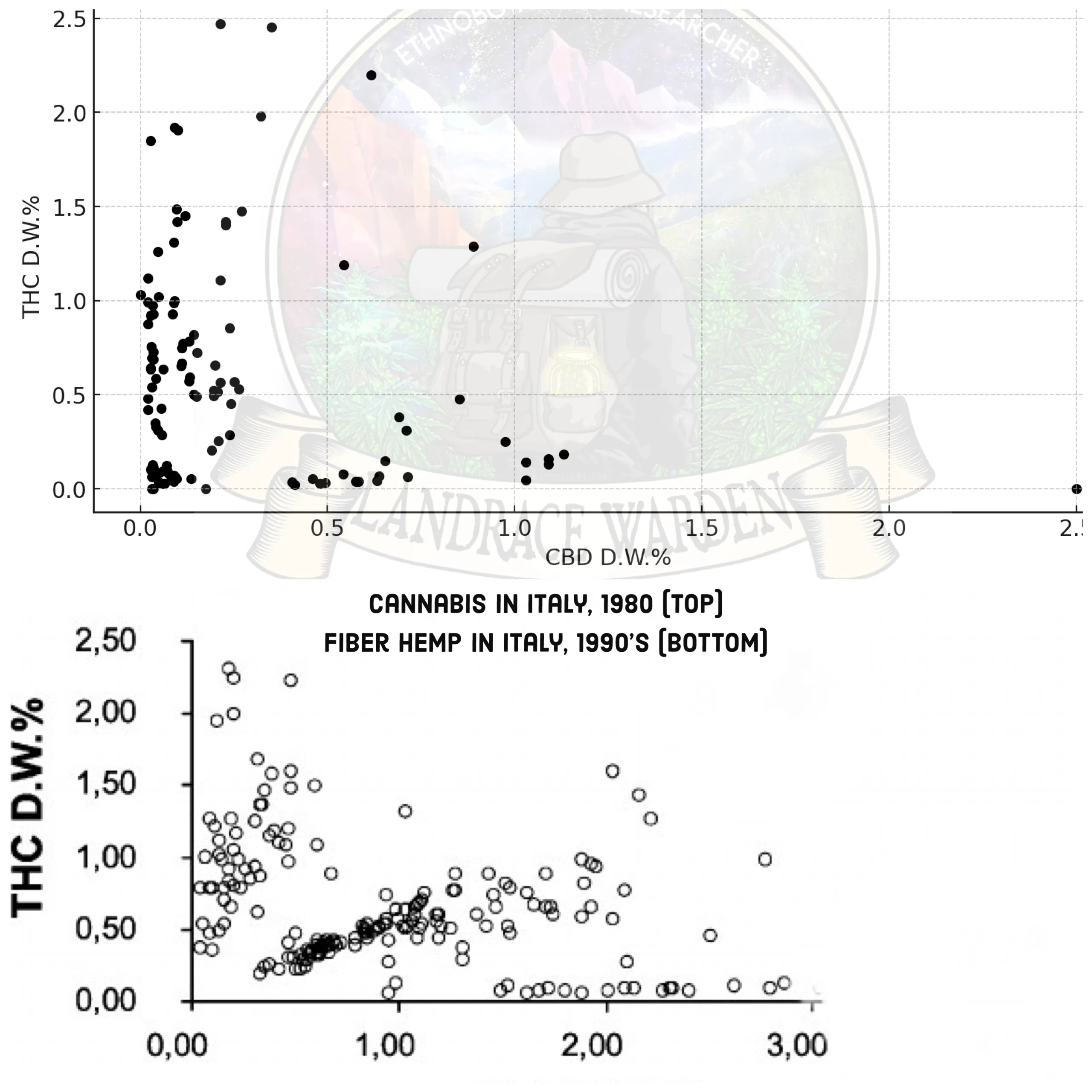

While many voice skepticism that cannabis of that era was so low in THC, the data shows much of it was. However, a higher resolution discussion would be focused on changes in ratios, ratios of THC to other trace cannabinoids besides CBD, terpene ratios, and total terpene content to THC ratio. The point is, a traditional Italian hemp fibre variety in the 1990’s contained as much THC in some phenotypes as was common for ‘illegal consumption’ in the region less than 20 years prior.
2% THC Cannabis
Those results weren’t a one off either. In 1989, 449 cannabis plants and 26 ‘fruiting tops’ were analysed in Denmark. The average potency of outdoor grown plants was 0.87% THC, and for
greenhouse grown 1.35%, while the average of the ‘fruiting tops’ was 2.13%. Of the seized plants, 2 out of 10 would now qualify as ‘hemp’, CBD dominant with low trace THC.

Despite attempts to reduce BT alleles in cannabis for industrial use, a study in 2020 of 62 agricultural hemp cultivars grown in Europe found ‘the presence of up to 35% BT allele-carrying
individuals (representing either a THC-predominant or an intermediate chemotype) in some cultivars - which is unexpected considering the legal THC limit of 0.2% THC.’
A look at the average % of cannabinoids found naturally in the various cannabis biotypes shows that the idea of ‘hemp’ being low in THC, or always being CBD dominant, would be an EU centric view on the industrial use of the cannabis plant.

What About In The USA?
From the 1970 study in North Carolina “the preparation analysis of enriched and pure cannabinoids from Marihuana and hashish” Of 10 samples from New Jersey, Minneapolis, Massachusetts, concentrations ranged from 0.22% - 1.08% THC, and up to 2.7% CBD.

Hemp, The Non-Narcotic Use Of The Cannabis Plant
In places like Nepal that have traditionally used hemp to make clothes and textiles, the plants were not low in THC, but rather, cannabis varieties optimising for multi-cropping. Seeds for
nutrition, hand-rubbed charras for medicinal or narcotic purposes, and the fibre from the plant used to make hemp products such as clothes as textiles. This description also aligns with the UK
governments interpretation as they issue ‘low-THC cannabis licenses’ for the purpose of producing ‘industrial hemp’, while, the flowers and resin remain controlled as ‘cannabis’ in the UK.
Finola Hemp
Finola hemp variety has been widely grown for over 20 years, and some wild throw-back expressions still emerge that are completely different from the rest of the crop. Pictured here is
one of my favourite expressions that can be found, it reminds me of a primeval biotype of cannabis, a throw back to the earliest progenitors of the species with its basic 3 pronged leaf. On
this particular specimen, a single, elongated middle leaflet, with a very short leaflet on either side. The stems are resinous, and given the morphological difference, and the range of terpenes found throughout the crop, we can only assume cannabinoid ratios will vary also. The cross breeding of Asian and European hemp in the last 100 years has increased the presence of BT allele-carrying individuals in EU hemp varieties.

Clearing The Confusion And Celebrating The Plant!
In the UK and other countries, the word ‘cannabis’ carries negative connotations for many, while ‘hemp’ is often viewed differently. In celebration of the plant, a pharmacological treasure trove that has accompanied us around the world providing food, clothing, medicine and recreation, we need to recognise that all of the benefits hemp can bring to humanity and the environment, is because of the cannabis plant!
-----------------------------------------------------------------------------------------------------------------------
References:
https://pubmed.ncbi.nlm.nih.gov/21653452/
https://pubmed.ncbi.nlm.nih.gov/9288590/
https://www.researchgate.net/figure/Chemotype-distribution-of-the-old-Italian-fiber-cultivarEletta-Campana-This_fig3_225865127
https://www.unodc.org/unodc/en/data-and-analysis/bulletin/bulletin_1980-01-01_4_page007.html
https://link.springer.com/article/10.1007/BF00200245
https://pubmed.ncbi.nlm.nih.gov/31770468/
http://www.internationalhempassociation.org/jiha/iha03114.html