
The phenomenon of enhanced hardiness in cannabis plants can be explained in several ways. From vigorous parents and seed coat mutations, hardiness is a multifaceted trait. Not only is the parent plant's health important, but the parent plant's experiences can indeed impose changes in the offspring's gene expression, too. This is the principle of epigenetic inheritance - inheritable changes that do not alter the DNA sequence itself. Here, we discuss how it works and its importance in cannabis seed selection.
What Is Epigenetics?
Epigenetics typically refers to alterations in gene expression, also known as transcriptional regulation changes. What's particularly fascinating about these changes is that they can be imprinted onto the next generation. This means epigenetic changes can be inherited or confined to an individual organism. The heritable kind, often termed epigenetic imprinting, involves modifications in the germ cells (sperm/pollen and egg/ovum), which are then passed down to the offspring. These modifications can influence the expression of genes of specific traits in the next generation, all without altering the DNA sequence. For example, certain characteristics acquired in response to environmental or stress stimuli can be inherited.


Conversely, epigenetic changes within an individual organism occur as shifts in gene expression, possibly restricted to specific life stages like the flowering phase – terpene synthases are very much under epigenetic control and not expressed much, for example, in early life stages. These changes, often triggered by environmental factors like day length, stress, and temperature, or simply as part of the plant's development/ageing, can be stable throughout the organism's life. However, unless the expression profile is imprinted in the germ cells, it is not typically passed to the next generation. This dual role of epigenetics can impact an individual's development and leave a heritable mark on the next generation, making it a significant evolutionary development. In this sense, epigenetics is a dynamic layer of regulation that has lasting effects on an individual's development and the potential for intergenerational inheritance.
The phrase "epigenetics" itself was first coined by British developmental biologist Conrad Hal Waddington in the early 1940s. Waddington used the term to describe the interactions between genes and their environment, which bring the phenotype into being. The concept of epigenetics has evolved significantly since Waddington's time and now commonly refers to changes in gene expression that do not involve changes to the underlying DNA sequence.
Epigenetic Imprinting In Cannabis
Epigenetic imprinting occurs when certain genes are marked or 'imprinted' during the formation of pollen and ovum (gamete). This leads to the gene being expressed as it was in the parent, even when it wasn’t the default state in the parent. This imprinting can remain during embryonic development and throughout the individual's life. For example, a mother plant, or in some cases even the dormant seed, may be exposed to cold temperatures and, therefore, forced to activate cold-response pathways to deal with the cold. If under epigenetic inheritance, these pathways can remain active throughout the offspring's developmental stages, making it much more ready to deal with cold stress. This has been proven in many organisms, including at the behavioural level in mice, and is commonly documented in many plant species.
The cold treatment of seeds for increased germination is called stratification, and the cold treatment of plants to induce flowering is called vernalization, e.g. in winter wheat. Cannabis has minimal research in this area but appears to work with the same principles. Many examples in cannabis plants point to stressors in the environment as triggers; inevitable fluctuations in temperature, water scarcity, pest pressure, nutrient limitation, etc, can trigger epigenetic changes. These changes, in turn, can lead to an increased stress tolerance in the seeds produced by these plants. This can leave offspring with pre-conditioned pathways for stress response, potentially giving them a survival advantage in similar harsh environments.
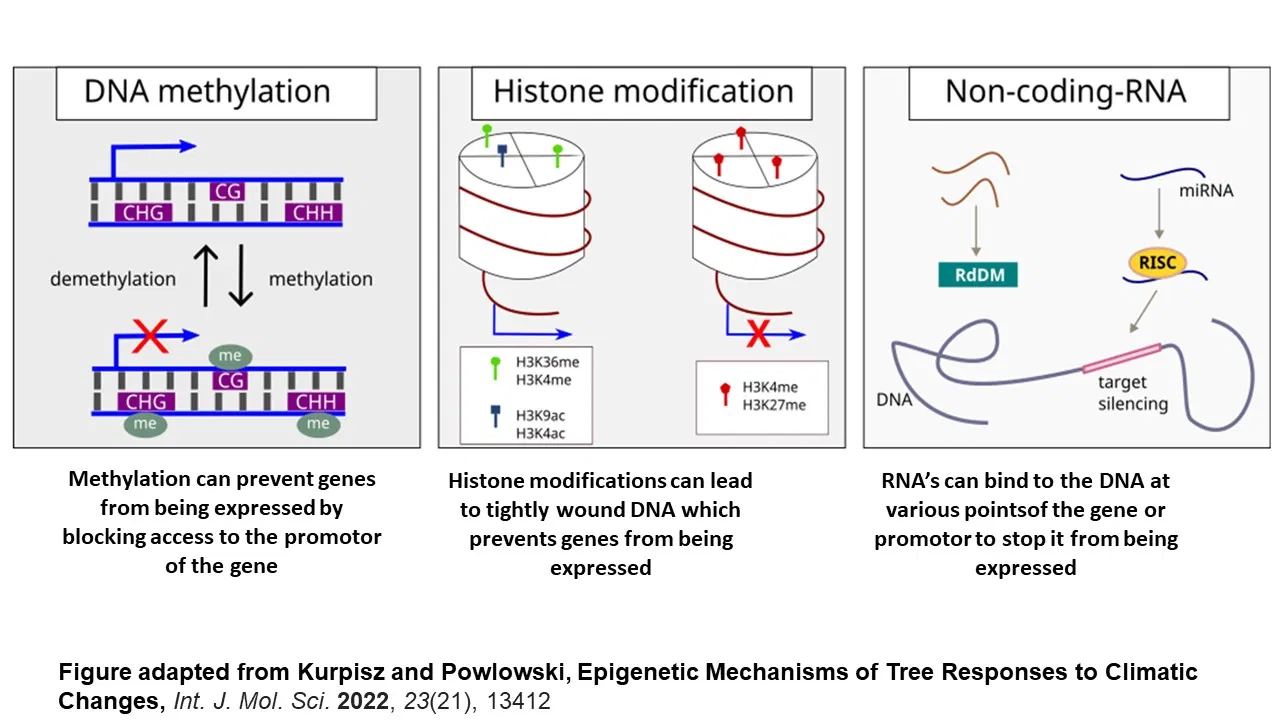
Mechanisms of Epigenetic Imprinting
In general terms, epigenetic imprinting does not alter the sequence of the DNA itself but rather alters how the genes are read and turned into protein (expressed). These modifications, which often function in how accessible genes are to be read, can include mechanisms such as DNA methylation, histone modification and non-coding RNAs, all known to be accelerators and/or brakes for gene expression. Epigenetic imprinting results in heritable changes in gene expression that do not involve alterations to the underlying DNA sequence. These changes can affect how genes are turned on or off, but the genetic code itself is not mutated —the sequence of A’s, T’s, C’s, and G’s remains unchanged. Genetic mutations, on the other hand, would change the sequence, but epigenetic mechanisms do not.

Epigenetic imprinting is a sort of ‘gene expression’ memory, allowing an organism's experience to influence gene expression in the offspring. Transcriptional regulation allows an organism to respond and adapt in real time to immediate internal and external cues; these epigenetic phenomena aid survival and allow plants to thrive even under stress.
Hardiness: Are You Ready?
Through these mechanisms, a cannabis plant can rapidly alter its physiological responses to stress. This ability to adapt swiftly can be crucial for survival, as it allows the plant to cope with immediate environmental changes. Stress conditions experienced by parent plants can lead to epigenetic changes passed on to the seedlings and might influence the stress tolerance of the next generation. Therefore, managing the stress levels of cannabis plants not only has implications for current crop yields but may also affect the resilience and characteristics of future crops. This is why outdoor-grown plants should be grown from outdoor-bred seeds, especially in fluctuating environments! The epigenetic imprinting from the mother plant can allow seeds to be much more ready for harsher environments than, say, indoor-bred plants of the same gene pool. Overall vigor can challenge that principle, but it is better to have hardiness on top of hardiness i.e. from vigorous parent lines and then bred outdoors.

Seeds that are harvested, for example, in the late part of the season, with wetter and cooler temperatures, even if it's only night temperatures that drop, will be much more resilient to an early spring cold snap, where the cooler temperatures might prevent some seedlings from thriving if not pre-conditioned by the parent. In this way, plants of the next generation can improve their survival without the typical mutations caused by selection pressure.
Genetic Mutation versus Epigenetic Imprinting
Unless catastrophic changes force a near-extinction event, epigenetic imprinting can influence the population much quicker than a genetic mutation. It is also true that the power of epigenetics is limited because it is generally an on-or-off switch for genes already in the genome. At the same time, mutations can give rise to new genes (functionally) and different levels of gene expression. Epigenetic imprinting offers a chance for rapid changes throughout a population, a process that takes effect sooner than genetic mutations. Mutations generally start from a single individual only, then in the next generation, only that individual's children and so on, taking longer to reach population-wide levels. Through mechanisms like DNA methylation or histone modification, epigenetic changes can turn genes on or off permanently, where they were previously only ‘on’ during certain points in the life cycle. This is a powerful tool for organisms to swiftly adapt to their surroundings; within a single generation, the population can be significantly improved in this way. This rapid response allows populations to adjust more quickly than they could through genetic mutations alone.
For example, a plant species exposed to sudden drought might activate mechanisms to deal with water shortage, and through epigenetic imprinting, this mechanism could be passed to the next generation in the active state, rapidly influencing the population's ability to survive in drought from the seedling stage. However, the power of epigenetic changes is somewhat limited by its nature. Unlike genetic mutations that alter the DNA sequence and can create new genes or change a gene’s function, epigenetic modifications work with existing genetic material. They do not add new information to the genome but instead regulate the expression of the genes already there. This regulation is typically binary, like an on/off switch for gene expression, although it can involve more nuanced regulation of the levels of expression, too.
In contrast, mutations can potentially introduce a broader spectrum of changes. They can lead to the development of new traits, offer different levels of gene expression, and even produce entirely new proteins. While slower to manifest in a population, these mutation-driven changes contribute to the long-term evolution and diversity of species by gradually introducing new genetic variations.
Seed Selection and Epigenetics
When selecting cannabis seeds, understanding the role of epigenetic inheritance is crucial for ensuring hardiness and adaptability in various environments. Based on the principles of epigenetic imprinting, seeds derived from plants that have experienced and adapted to specific stress, particularly in outdoor or variable environments, are likely to inherit enhanced resilience. This epigenetic lesson is passed on, which means the seeds may have pre-conditioned pathways to better cope with similar stresses their parent plants faced, such as temperature fluctuations or water scarcity. Although seeds can be stratified (cold treated to simulate a winter season), often the result is more consistent germination rather than gene expression changes.
Things to consider:
Source: Opting for seeds from plants grown in environments similar to where they will be cultivated, or seeds from outdoor-bred plants for outdoor growing is sensible. These are often more suited to handle the unpredictability of outdoor growing conditions due to the potential epigenetic adaptations of their parent plants.
Parent Plant Stress Exposure: Healthy parent plants that have successfully adapted to specific environmental challenges will likely produce seeds with improved hardiness. If looking for particular stress resilience, such as cold or mold tolerance, seek seeds from plants known to have thrived under those conditions or better yet selected for under these conditions.
Harvest Timing: Consider the time of the year when the seeds were harvested and where they are from. Seeds collected late in the season, potentially under more stressful conditions (cooler, wetter), may carry epigenetic marks that contribute to hardiness in similar future conditions.
------------------------------------------------------------------------------------------------------------------------
REFERENCES:
ScienceDirect.com - Epigenetics in plants: Vernalization and hybrid vigor
ScienceDirect.com - Vernalization and epigenetics: How plants remember winter
Genes | Free Full Text | Plants' epigenetc mechanisms and abiotic stress
Diagram reference: https://www.mdpi.com/1422-0067/23/21/13412
Seedsman's latest F1 FAST strainshave been bred from the finest indoor cuts, and selected for outdoors, in California. This means plants aren't just potent and tasty; they're also highly vigorous and adapated for harsher conditions. If grown indoors, you can achieve craft quality cannabis. If grown outdoors in harsh conditions, they will still provide an incredible quality.