

Most people think of cannabis as something that simply makes you “high.” But what if that feeling is actually the visible tip of an iceberg of intricate neurological chemistry? Beneath the calm (yet giggly) surface, marijuana sets off a cascade of changes in how the brain communicates, how signals are sent and received, and even how pleasure, memory, and motivation are wired together. Scientists have spent decades trying to map this interaction, and they keep finding the same thing: cannabis doesn’t just nudge the brain – it negotiates with it.
At the centre of this negotiation is the body's own cannabinoid network, the endocannabinoid system, and its primary point of contact - THC (tetrahydrocannabinol), the compound that gives cannabis its psychoactive kick. What follows isn't just a story about getting high; it's about how this ancient plant can momentarily reshape the chemistry of thought itself.
THC & The Endocannabinoid System: The Basics

To understand marijuana's effect on the brain, you first need to meet the brain's own cannabis-friendly system: the endocannabinoid system (ECS). This network of receptors, endocannabinoids, and enzymes exists throughout the body and brain. It helps regulate mood, memory, appetite, pain, and even immune function[1].
Here's how it works in plain English: your body produces its own cannabinoids (like anandamide , aka the 'bliss hormone,' and 2-arachidonyl glycerol) that bind to cannabinoid receptors (mainly CB1 in the brain and CB2 in the immune system). They modulate neuronal activity, acting like finely-tuned brakes to keep things balanced[2]. Enter THC. Because it mimics your body's own cannabinoids, it can attach itself to the same CB1 receptors - especially those dense in the brain's reward and memory regions - and essentially take over the controls [3]. The result? A shift in neurotransmitter release, altered signalling, and the distinct cognitive and sensory changes we associate with being high.
When that happens, several things kick off:
- Altered dopamine release: THC's impact on reward pathways increases dopamine in certain brain regions, producing pleasure and reinforcement.
- Modulation of GABA and glutamate: THC alters the brain's inhibitory (GABA) and excitory (glutamate) balance, reshaping communication between neurons [4].
- Effects on memory and mood: THC interferes with the hippocampus and prefrontal cortex - key areas for learning, decision-making, and emotional regulation [5].
So, when you consume cannabis, you're not just indulging in a fleeting high - you're interacting directly with one of the most essential signalling systems in the human brain.
The Entourage Effect: Myth, Reality, Or Marketing?
If THC is Huey Lewis, the rest of the cannabis plant is The News - that's the cannabinoids, terpenes, and flavonoids that may contribute to enhancing the main effect in subtle or significant ways. Known as the entourage effect, this synergy suggests that cannabis compounds work together to produce effects beyond what any single one can achieve [6]. This idea didn't just arrive out of nowhere. It was first articulated in 1998 by researchers Dr Raphael Mechoulam and Dr Shimon Ben-Shabat, who observed that naturally-occurring cannabinoids became more potent when combined with related, non-active compounds. This finding would lay the groundwork for the notion that cannabinoids and terpenes in cannabis could act together in a similar way.
A key follow-up came from Ethan Russo, who, in 2011 published a detailed review exploring how cannabinoids and terpenes might synergise to enhance therapeutic potential. Russo's paper remains one of the most cited in the field, offering evidence that cannabis may well be more than the sum of its parts - a hypothesis that continues to guide research into full-spectrum extracts to this day.
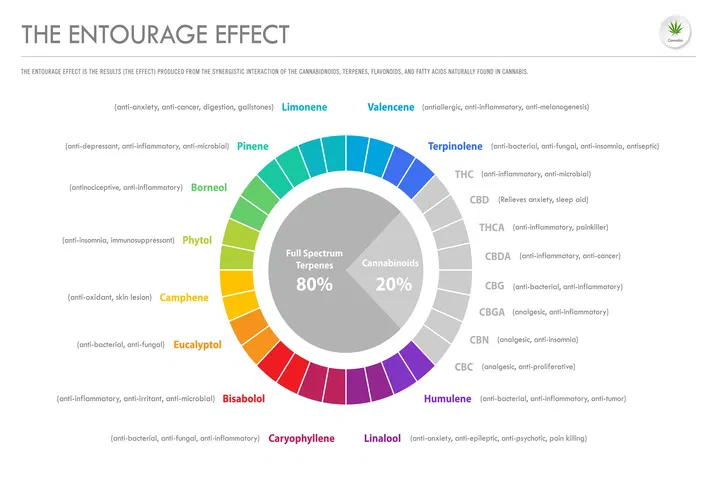
But here's where things get tricky: while the theory is seductive, the science is still double-checking. A 2023 scoping review concluded that "existing pre-clinical and clinical studeis show contradictory findings" and that most of the current evidence remains anecdotal [7]. Another systematic review found no conclusive proof that terpenes significantly boost or modify THC's psychoactive effects, despite their biological activity [8]. These findings fly in the face of what many in the cannabis community have long taken as gospel.
Despite these recent reports, it is plausible that compounds like myrcene (thought to promote relaxation) or limonene (linked to elevated mood) could subtly influence how THC feels. It's just that we can't yet quanitfy or predict those effects with the scientific precision required to satisfy certain scholars.
In short: the entourage effect is a useful concept and may explain why full-spectrum cannabis extracts can feel smoother or more balanced than pure THC - but perhaps we shouldn't treat it as gospel just yet.
Marijuana's Effect On The Brain
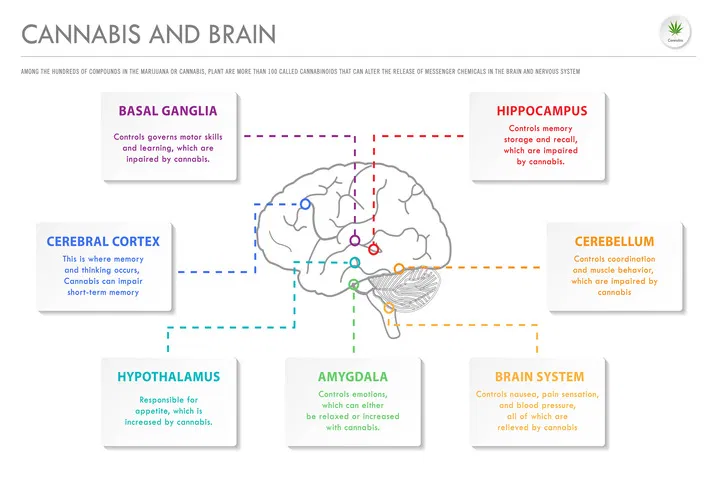
When we're looking at marijuana's effect on the brain, one thing is clear: this involves multiple dimensions. Firstly, there are neurochemical and immediate effects, so when THC binds to those CB1 receptors, it sets off a flurry of activity.
Reward and Pleasure: THC interacts with the brain's dopamine (reward) system, especially the nucleus accumbens, to create those heady feelings of euphoria - although chronic exposure can blunt this response over time [9].
Stress and Mood: The endocannabinoid system normally keeps the stress response in check. Among marijuana's effects on the brain include its ability to temporarily enhance relaxation (Hi, couch-lock!) but, with repeated use, may alter the brain's sensitvity to stress and reward [10].
Memory: The stoner stereotype has long included forgetfulness as one of marijuana's effects on the brain, and it's not without basis. This is because the hippocampus, rich in CB1 receptors, is particularly sensitive to THC. That's why users sometimes struggle to recall short-term events while high [11]. Suddenly, it all makes sense, right?
Signal Interfence: THC mimics natural endocannabinoids, influencing GABA and glutamate levels - key neurotransmitters for information processing.
The endocannabinoid system was only discovered in the 1990s - decades after cannabis use became relatively widespread - proving that THC helped scientists uncover a previously unknown biological system. It's like there's nothing cannabis can't do!
Structural & Functional Brain Changes
When looking at marijuana's effect on the brain over time, research paints a complex picture. Regular users often show altered activation patterns on fMRI, sometimes engaging extra brain regions to maintain task performance [12]. And, it shows that during teenage years, the brain undergoes synaptic pruning. THC exposure during this window may disrupt these processes, leading to long-term changes in connectivity and cognition [13]. And speaking of cognition, evidence for permanent IQ loss is mixed - some studies do suggest minor declines, while others show recovery after prolonged abstinence [14].
Body Responses: Tolerance, Dependence & Recovery

The brain doesn't act alone - its responses ripple through the entire body. With consistent exposure, CB1 receptors become less responsive, meaning more THC is required for the same effect - in other words, the more frequently you consume cannabis, the more (bigger dose) you typically need to recreate your personal sweet spot in terms of effects. And while cannabis is not physically addictive in the same way as say, opioids, heavy use may reshape reward and stress pathways, leading to mild withdrawal or cravings. You can read more about cannabis withdrawal here.
Brain function can rebound after abstinence, though - some studies show partial recovery in memory and attention after just a few weeks without cannabis [15]. Like anything, then, the key to safe and successful cannabis use is to not overdo it. But many of marijuana's effects on the brain can be corrected by refraining for a period. This is known as a tolerance break, and comes with the benefits of something of a resest in terms of both how much cannabis effects you in both the short and longer term.
What Marijuana's Effect On The Brain Really Means
So what can we conclude from this whirlwind tour through marijuana's effect on the brain? Well, THC isn't a simple switch - it engages a major homeostatic network (the ECS) that governs mood, pain, and cognition. Effects depend heavily on context, and everything from frequency of use, strain type, your age, genetics, and even mental health all influence outcomes. Risks vary by stage of life - the younger the brain, the more delicate the balance. If you're exploring cannabis - whether recreationally or medicinally - keep these things in mind and consider the following grounded tips:
- Start low, go slow: moderate doses reduce the risk of tolerance and cognitive effects.
- Avoid heavy use in adolescence, as the developing brain is particularly sensitive.
- CBD may temper THC's intensity. Balanced strains can feel clearer and less anxious.
- Mind your tolerance - taking tolerance breaks can help reset the ECS.
- Consider your own neurochemistry . People prone to anxiety, depression, or psychosis should use extreme caution when considering cannabis use. Remember, the 'high' is just one part of a much bigger conversation between your brain and the cannabis plant.
Marijuana's Effect On The Brain: Final Thoughts
In the end, marijuana's effect on the brain is a story of chemistry meeting consciousness. THC doesn't simply light up your neurons - it rewrites, however briefly, how they talk to each other. Whether that results in sheer bliss, introspection, or couch-bound contemplation depends on a merry dance between molecules, mood, and moderation. The entourage effect, the ECS, the brain-gut link - all these remind us that cannabis is less a single compound and more a complex biological dialogue. The science is still unfolding and like any good story, it's full of twists, turns, contradictions, and cliffhangers.
The next time you're deep in thought after a puff, know that your neurons are busy having a lively debate of their own - one that's been taking place for millennia, only now we're finally learning the language.
--------------------------------------------------------------------
References:
[1] https://pmc.ncbi.nlm.nih.gov/articles/PMC7855189/
[2] https://pubmed.ncbi.nlm.nih.gov/22804774/
[3] https://pubmed.ncbi.nlm.nih.gov/32980261/
[4] https://pubmed.ncbi.nlm.nih.gov/18422832/
[5] https://pubmed.ncbi.nlm.nih.gov/22804774/
[6] https://pmc.ncbi.nlm.nih.gov/articles/PMC7324885/
[7] https://pubmed.ncbi.nlm.nih.gov/37626819/
[8] https://pubmed.ncbi.nlm.nih.gov/39598452/
[9] https://pubmed.ncbi.nlm.nih.gov/27618739/
[10] https://pubmed.ncbi.nlm.nih.gov/27618739/
[11] https://pmc.ncbi.nlm.nih.gov/articles/PMC7027431/
[12] https://pubmed.ncbi.nlm.nih.gov/18422832/
[13] https://pmc.ncbi.nlm.nih.gov/articles/PMC7027431/