In this second part of the series, we will closely examine some of the other ambiguous terminology commonly used in cannabis. First, however, it is worth noting that the use of language can be specific to the local area, region, country, and even continent. The cultural and social context of a geographical area profoundly influences language. Words and phrases that are commonplace in one place may be completely unknown or have different connotations in another. This regional specificity can lead to misunderstandings, especially when technical or specialized terms are involved. Separate from any given subject, information can be warped due to translational ambiguity as it is not always the case that the translator is also the subject expert, and therefore, things can literally get lost in translation.
The problem arises because many words and concepts do not have direct equivalents in other languages. This can lead to a situation where the translator must choose the closest available term, which might have different connotations or imply a different context. Even within the same language, we can see disparity in the words used to convey certain messages. This is evident in the variations between British and American English, for example, where the same word can have different meanings or different words are used for the same concept. For example, plants bred for fast flowering times can be called earlies, quicks, fast, or even semi-full term! These are at least descriptive of what the name is trying to convey. In many specialized fields, professionals must develop a specific jargon to streamline communications and condense complex information, which can often be almost incomprehensible to the non-expert. This creates a communication barrier across languages and within the same language. Efforts to bridge this gap, such as the plain language movement in legal and medical fields, aim to make information more accessible to the general public.

Some topics are inherently complex and require a thorough, detailed explanation to be fully understood. For example, the subject of DNA and its mechanisms. While it's possible to use simpler language and break down the information into basic concepts, the inherent complexity of DNA's structure and function cannot be undone. Although you can make the explanation more accessible, you can't simplify the actual complexity of the subject matter. Therefore, while simplifying language is often recommended to make complex ideas more understandable to a broader audience, there are cases where enhancing the vocabulary and understanding of specialized terms is necessary. In these instances, deepening knowledge and familiarisation with specific terminology becomes essential to grasp the full intricacy of the topic.
Stress, Or Dressed For Duress?
One of the most frustrating misuses of language in cannabis cultivation is the term 'stress'. There is a split between those who use it correctly and those who do not, but the implied meaning often grates on my ears. To say that cannabis plants 'love stress' or that they need to be stressed to perform optimally is a fundamental misunderstanding of the plant's biology and an absolute abuse of the word 'stress'. We can consider the growers of cannabis plants as 'trichome farmers', focusing on optimizing conditions to maximize cannabinoid production. In this context, conditions often labelled as 'stress' are actually the optimal conditions for the specific goal of enhancing trichome production. For instance, adding UV light or exposing plants to lower temperatures might increase trichome production, but this should be seen as part of the optimization process, not as inducing stress. Some indeed theorize cannabinoid production as a plant's stress response mechanism. However, this theory is not universally accepted, and if plants produce cannabinoids naturally without obvious stressors, it's misleading to say they 'need' or 'love' stress.
This type of miscommunication causes confusion, especially among beginners. Misguided practices, like driving nails through stems or shaking plants violently under the belief that 'stress' enhances their performance, are a direct result of this confusion. Take, for example, the intensity of light used in cannabis cultivation. Such high light levels would trigger a high-light stress response in most other plants. Yet, in cannabis cultivation, we recognize this as optimizing light utilization, not as inducing stress. It highlights that if certain conditions elicit a beneficial chemical or physiological response from the plant, those conditions become part of the optimization process to yield the best results rather than being seen as inducing stress. Usually, in plant biology stress factors will inhibit growth, reduce cannabinoid production or worse, i.e. lead to a hypersensitive response, which will trigger self-destruction of particular cells in the face of stress. It would be more fitting to say plants are under duress to maximize performance, i.e. a constrained set of conditions (such as a grow room), geared towards an output that would otherwise not occur!
Strain: The Wrong Name In The Wrong Game!
This term has become a more well-known example of bad language, but that doesn’t prevent repeated misuse. The term strain has been widely adopted in the cannabis community as a way to tell different types of plants apart. In no other plant do we refer to the different varieties or cultivars as strains. This word is largely borrowed from microorganisms, and in particular, viruses. The subtle difference in language or terminology can be more helpful than a hindrance. For example, if there is a new cannabis ‘variety’, it should technically be described as a variety only if it is a naturally occurring variant found and then brought into the cultivation world; hence a new variety is available.
Should the new cannabis variant be produced by breeding practises, selected or even phenohunted for specific traits, then a new cultivar (cultivated variety) is the proper way to describe this. Although there is a fair bit of debate about the proper origin of specific types, ruderalis, sativa and indica, these should be described as subspecies. Then, the type called a variety is naturally occurring, such as many of the selections in the range of the Landrace Warden. Otherwise, it should be called a cultivar if specifically bred or selected, such as the selection from Seedsman.
On the other hand, the term "strain" has become firmly established within the cannabis industry and its culture, serving as a key linguistic tool for identifying and differentiating various types of cannabis. Its widespread use by growers, sellers/prescribers, and consumers has solidified its place in the industry's vernacular, making it a clear and commonly understood term. This broad adoption and recognition render "strain" an effective and practical term for everyday communication in the cannabis community. Additionally, "strain" offers a non-technical, accessible language for the average consumer, who may not be familiar with more scientific classifications like cultivar or variety. Its use in marketing further enhances its relevance as the term resonates with consumers. This aids in the branding and promotion of different cannabis products. People have grown accustomed to seeking out specific "strains" based on desired effects, flavours, or potencies, underlining the term's practicality and importance in the industry.
Bud Or Nug, Flower Or Inflorescence: Do You Know What You're Smoking?
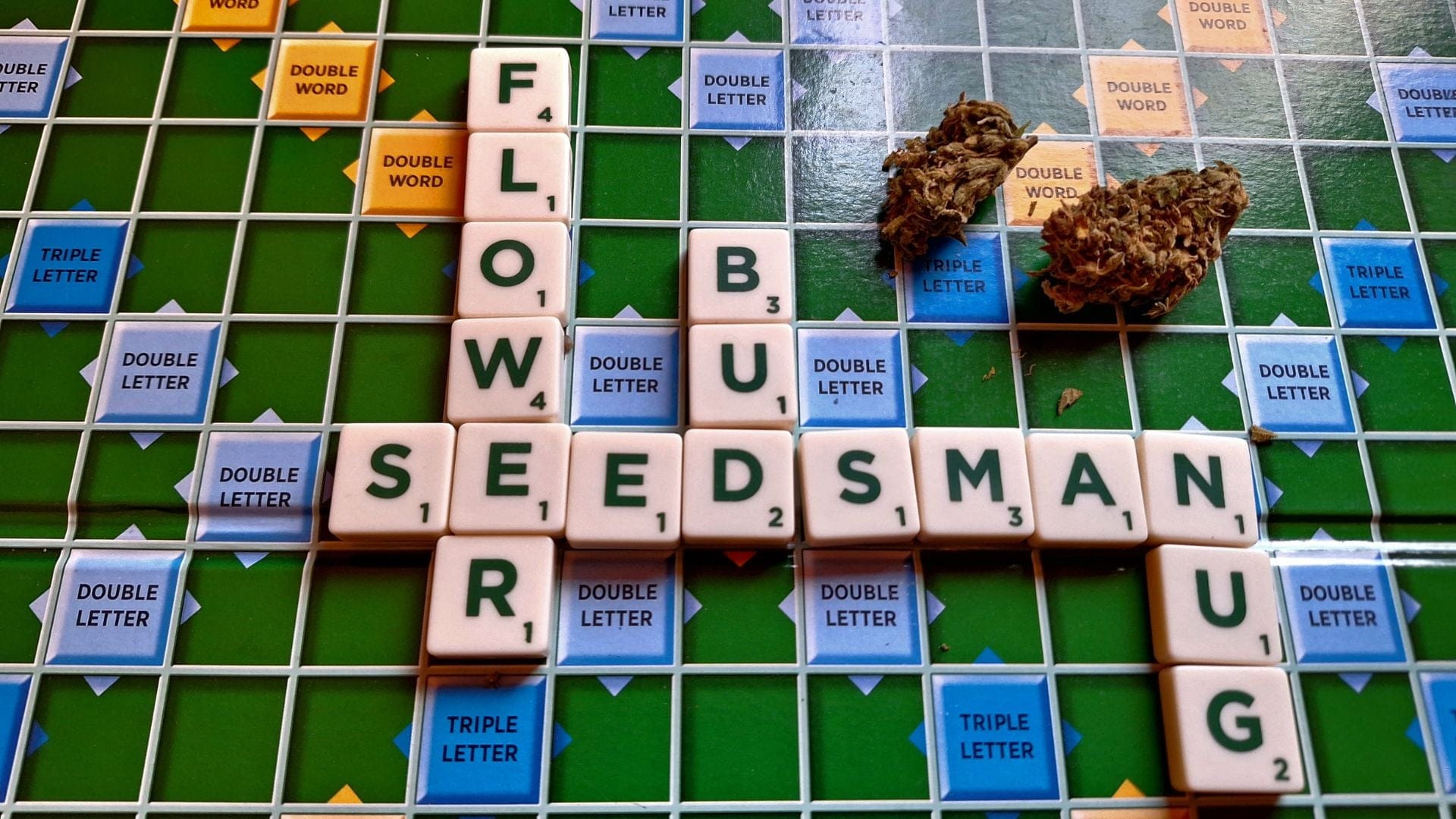
The three commonly used terms for the smokable part of the plant are "flower," "bud," and "inflorescence." The word flower refers to the individual reproductive unit of the cannabis plant. These are the structures that play a crucial role in the plant's reproduction process and are highly valued for their rich concentrations of cannabinoids and terpenes. On the other hand, the term “bud” is popularly used in casual contexts to describe the part of the cannabis plant that is harvested and prepared for consumption. However, from a botanical standpoint, what is often referred to as a "bud" is actually a tight cluster of these unfertilized female flowers. The most precise botanical term for this part of the cannabis plant is "inflorescence." This term describes a group or cluster of flowers arranged on a stem. The inflorescence is the entire cluster of these female flowers, encompassing what is commonly called a bud in everyday language. Therefore, "inflorescence" is the most accurate botanical term for the smokable clusters of female flowers highly prized in cannabis cultivation and consumption.
Conclusion
Our exploration of cannabis terminology is far from done, as it becomes increasingly clear that the language surrounding cannabis cultivation is not only complex but also deeply influenced by cultural, regional, and linguistic factors. These influences often lead to the varied and sometimes inaccurate use of terminology, as seen in the misapplication of the terms outlined in this series. Furthermore, the widespread use of the term "strain" in the cannabis industry, despite its traditional association with microorganisms, highlights the evolving nature of language in specialized fields. While technically a misnomer, this term has become embedded in industry parlance, demonstrating the dynamic interplay between technical language and everyday usage.
History is full of examples of words that get reappropriated for different uses over time, usually influenced by key figures or cultural collectives. At some point, it is better to go with the flow rather than swim against the current; after all, ‘awful’ used to mean something worthy of awe, as the word suggests, but now it means the opposite! So, should the cannabis community fight back against the ‘dictionary dictators’ and claim the word 'strain' for the industry? A question for the masses rather than the scholars, perhaps!