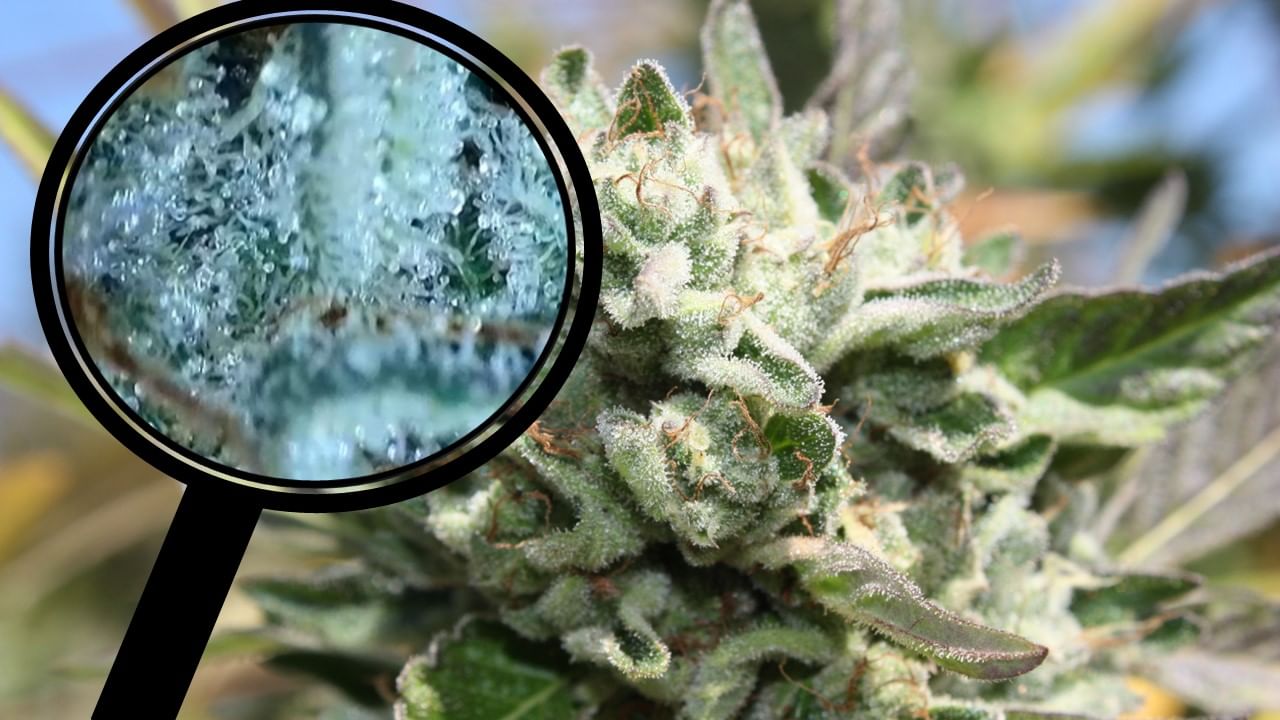
Cannabis is a plant renowned for its complex chemical makeup and multiple diverse uses. While many of us are by now familiar with the appearance of the plant and its various structures, it's revealing to see what's going on close up and in greater detail. This series of images offers a detailed exploration of the plant's anatomy, highlighting the nuances that set apart various cannabis tissues and types from one another and their respective applications. From the structural composition of its stems to the fascinating world of trichomes, each image provides a closer look at the unique characteristics of cannabis. Understanding how plants function and why certain features are important can become more obvious under the lens.
Each image here is set to provide a little more insight than the text book typically provides as information is often averaged for ease of writing. This is why images are so important to the understanding. For example, as a plant matures, it's common knowledge that the pistils change colour and the trichome heads go from milky to clear to amber. At any given point, however, it is much more likely to find a combination of all of these variations than just one, i.e. there are always exceptions to the rule.
A Closer Look At The Petiole
The image on the left shows the stalk as it meets the leaf. This stalk is called the petiole. It contains thousands of non-glandular trichomes, and it is rich in purple pigment, possibly due to high anthocyanin content. There is also an abundance of glandular trichomes, these tend to get denser nearer to the leaf. There is some data to support the idea that there is a higher abundance of glandular trichomes on the sides and underside of the sugar leaf than on the top. This can be specific to the variety and there are many exceptions to that rule. The image top right shows again, high abundance of trichomes, both glandular and non-glandular. Looking at it close up, it makes sense why so many people use these sugar leaves, and trimmed sugar leaves for making extracts such as bubble hash.

Cannabis Plant Stalk Tissue Revealed
Continuing with the stalk tissue, below we see an inflorescence (flower/bud) stalk called the peduncle, with images on left and centre. It is distinctly dark and again rich in pigments making purple coloration. The image on the left shows a broken stalk revealing the tissue inside, no cavity can be seen in the centre of the tissue (compare with image 8, 9, or 10) . If you look closely you can see the separation of the tissues inside but the vascular transport system is dominant and keeps the stalk tissue dense. This can make it more flexible and less likely to damage under mechanical force or when bent. However it also makes it brittle, and if pushed too far the bend will snap off, unlike main branches which will kink when bent too far, then regenerate, repair and strengthen that site of damage usually forming a ‘knuckle’ on the branch. The two images on the right show the abundance of non-glandular trichomes on the petiole, the odd bulbous trichome may be found on these tissues but generally they are low in cannabinoids.

Mature Seed In Early Flowering
The completion of the cannabis life cycle is the mature seed. The image below on the right shows a trichome-rich bract with a seed nestled in the back. Milky and clear trichomes would suggest this is early (around the halfway mark) in the flowering stage, but the seed coat is well-developed and already distinctly patterned. Not all trichomes will turn amber, especially in non-THC dominant plants. The image on the right is a seed that has been covered but the resin most likely due to touching/rubbing against tissue rich with trichomes. Physical interaction with the trichomes can cause residual oils or resin to stick to the object touching them.
Factoid: Interestingly, hand rubbing is a technique used to make a type of hashish called Charas. Collecting the resin on the hands, and then rubbing the hands together causes the formation of a soft oily, wax-like material which makes amazing hash. A tradition used in Asia for many generations. This procedure can be done on seeded cannabis, and when done from wild populations, it usually is always at least partly pollinated.

Cannabis Trichomes Up Close
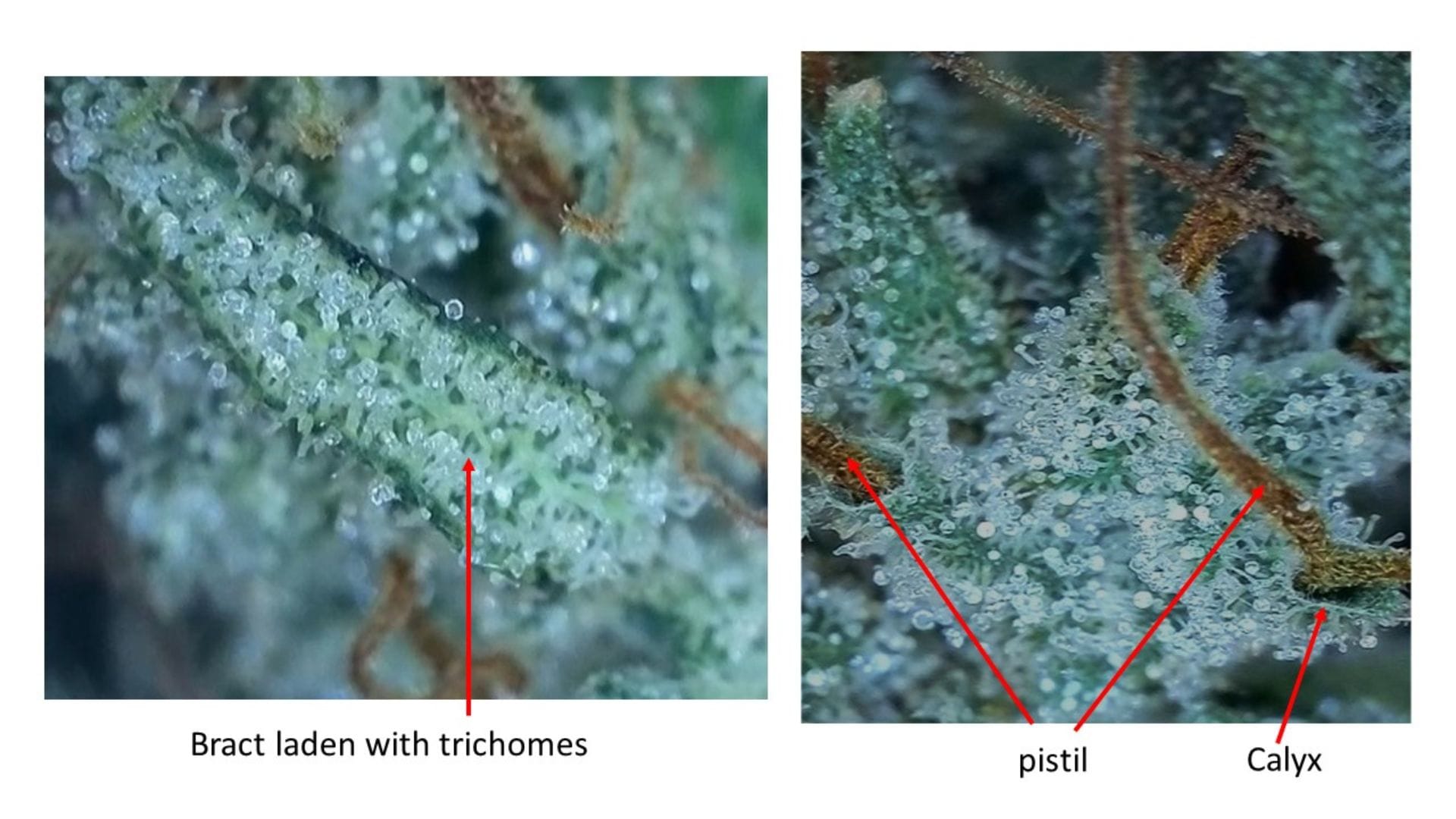
The image shows an early flowering bract with a dense coverage of trichomes. The trichome population in the image shows all 3 descriptions of glandular trichome, bulbous, capitate-sessile and capitate-stalked trichomes. Here, the majority look like sessile trichomes but it is hard to tell from above if a trichome is stalked or not. Later in development, the abundance of stalked trichomes will increase and at least one study has suggested that capitate-sessile and stalked are actually the same thing, and the sessile trichomes precede the stalked variety.

Mature And Immature Pistils
With both mature and immature pistils the images below help to show how the cannabis plant matures at different rates. They usually start as white or pale and gradually darken to orange, brown, or red as the plant reaches full maturity. The presence of both mature and immature pistils can indicate the ongoing maturation process. Here we also see translucent (clear-headed) capitate-stalked trichomes, with some milky-headed trichomes also in focus.
Factoid: Different positions within the plant may cause localised microenvironmental differences, which can cause cannabis tissues of the same type to mature at different times. This is also the case for some orchard fruits for example, which can ripen weeks apart. Cannabis is also like this, as most of the reproductive tissues of cannabis plants independently mature. However this variation can be reduced with tight environmental control, and limiting environmental stress.

Examination Of The Main Stem Of A Cannabis Plant
This image shows the main stalk, i.e. the stem of the plant, from afar and close up. Although it is often described as devoid of cannabinoids, the image clearly shows some bulbous trichomes on the stem. Although cannabinoid concentration is very low in these compared to the capitate trichomes, and there are very few, it is not devoid of cannabinoids. Trichomes serve many functions in plants with some highly specialised examples including: Trichomes motion/pressure sensors that trigger the closure on the venus fly trap upon touch (from an insect). The common nettle has trichomes which inject neurotoxins into the skin when touched. Certain members of the cacti family have dense, tough spikes or spines, which are specialized trichomes adapted to deter herbivory.

A Partly Dried Stem
This image shows a partly dried stem with an open split. The small image on the left shows where the close up on the right has come from. This is a plant with both fibrous (hemp) parentage and cannabinoid-rich parentage. The stem is not optimal for fibre but clearly shows two of the tissues that are utilised by hemp farmers and processors, hurd and bast. Hurd, also known as shives, is the woody, inner core of the stalk. This tissue is composed of short fibers. Hurd makes up about 70% of the of stem's mass in hemp and is typically found surrounding the plant's woody core. The bast is the fiberous part which is used traditionally in rope and clothing manufacturing. The pith is the softer internal tissue which is not always distinct from the hurd. However, the hurd and bast tend to be the most important tissue for the hemp industry.

How Cannabis Plant Stem Tissues Appear
In this cross-section image, we see the various tissues that comprise the stem. Distinguishing these tissues can be challenging without staining, so exploring other images is recommended for those interested in more detail. In traditional hemp, the stem's cross-section is typically more identifiable. Here, the hybrid's stem resembles that of a high THC cannabis plant more than hemp. Notably, traditional 'drug-type' cannabis, known for its high THC content, differs significantly from traditional hemp in the stem's composition, particularly in the ratio of various bio-materials and cellular deposits.
Factoid: Hemp has a higher ratio of cellulose and pectin compared to high THC cannabis stems. This composition makes hemp ideal for numerous commercial applications, such as hempcrete. Its fire-retardant properties are primarily due to its high silica content, which can be utilized in creating fire-resistant materials.

Conclusion
Each of the images shown offers a detailed look at the cannabis plant close up. Utilizing powerful imaging techniques has been a keystone in understanding cellular function in many fields of biology. Even at the macro-level displayed here, the coverage of trichomes, color of pistils and transparency of the trichome head, give insight to the age of the plants or at least its stage of maturity. Taken further, dissecting and looking at cell types inside the tissue also offers detail that the naked eye could miss. Knowing the parental lines of the plants being grown, combined with a more thorough macro or even micro-level of imaging, can reveal secrets that you never knew that plant was holding!
A special thank you to Kyle Esplin for the amazing images that made this article possible. If you want to learn more about what Kyle does, check out the Landrace Warden seeds available here at Seedsman or check out his Holistic Highland Hemp Company here.