
Plants see light using many different 'eyes', called photoreceptors. Most of these harvest photons to fuel an energy cascade, making photosynthesis possible. Some of these photoreceptors, however, work differently; they are not always involved in photosynthesis and are not all in the visible light spectrum! Learn more about what indoor and glasshouse plants are missing compared to outdoor sun-grown plants.
Indoors vs. Glasshouse vs. Outdoors – Not all is even When Lighting Cannabis
Cannabis cultivation takes many forms, from the traditional outdoors to advanced indoor and glasshouse setups. While each offers unique advantages, there are some drawbacks too. Here, we cover how the light spectrum differs in all three scenarios. For example, indoor lights typically provide a standard Photosynthetically Active Radiation (PAR) range. This is a limited spectrum compared to natural sunlight, and whilst not all wavelengths of light are photosynthetically important, they might be necessary in other areas.

For another example, glasshouses can block specific light spectrums, and breeders and growers of other crops have steered their plants to account for this. But how does all this change what the cannabis plant does and can do? To fully understand how these differences affect the cannabis plant, it's essential to go deep into the lesser-known aspects of plant light perception and the roles light plays beyond photosynthesis.
Indoor Gardens - Photosynthetically Active Radiation (PAR)
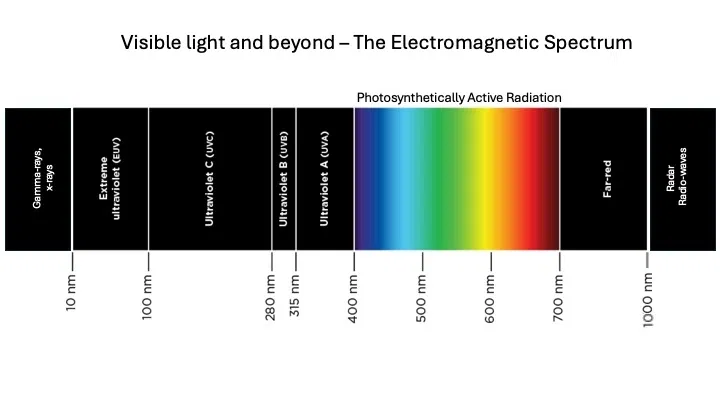
PAR is the range of light covered by the visible spectrum, the blues, greens and reds, with yellows and oranges in between. For completion, the non-visible wavelengths include ultraviolet, infrared, and other electromagnetic radiation forms, including gamma-rays, x-rays, radio-waves, etc. The cannabis plant and most other plants use light largely from the visible spectrums for photosynthesis, typically wavelengths from 400 to 700 nanometers (nm). It stands to reason, and given the energy required to power them, that indoor grow lights are designed to emit light within this range and nothing more to maximize photosynthetic efficiency. Usually, LED lights have a mix of something like 10-20% blue spectrum, generally peaking around 455nm, 35-40% green and 20-60% red. However, these can be customized to the species and the variety.
In general, much success has come from indoor growing, so it would be easy to assume that the entire lighting needs of the plant are met. However, one of the lesser-known issues with indoor horticulture is generally a lack of stress resistance. Whether biotic or abiotic, plants selected for indoor growing need a stable, controlled, clean environment to thrive. This is in part due to the selection of the varieties that have made it more suited to life in a bubble! A good lighting unit will emit PAR, and it will work incredibly well at feeding the photosynthesis needs of the plant, but the plant can see other types of light, too! So what's it missing?
Glasshouse – You and me, but no UV
Many horticultural crops are, and have been for decades, grown in glasshouses. Glasshouses can be made from different standards of glass and even some plastics, which all have slightly different effects on the light reaching the plants. In general, the glass will allow most or all of the visible light spectrum to pass through and can even allow the infrared spectrum to penetrate the growing area. However, glass naturally blocks or filters out significant portions of the UV spectrum and the lower wavelengths of light. In this sense, a glasshouse can be regarded as semi-permeable to light, and although it will provide the greater proportion of the spectrum, it will still filter out some of the wavelengths the plant can detect. In this way, again, glasshouse crop breeders can select plants less influenced by the missing elements of the spectrum, i.e., those regulated by UV light.

The Great Outdoors – All the Colors of the Moonbow
Fairly obvious to say, but natural sunlight covers the widest possible spectrum, from the sub-nanometer gamma and X-rays to extending far beyond the red spectrum into the infrared (IR) and emitting radio waves. Whilst these extreme ends of the electromagnetic spectrum are not as well documented in relation to plant function, some of the non-visible wavelengths, such as UV and far-red, can be crucial to plants beyond photosynthesis. But what do these extra wavelengths of light do, and how can it be leveraged for cannabis growing? First, it is important to understand how a plant perceives light, of which there are a few ways.

Catch a Falling Photon
Plants can perceive light in a few ways. Buckle up! Photosynthesis works as follows: As light is both a wave and a partial (photon), when a photon of a specific wavelength strikes a chlorophyll molecule, around 430-450 nm blue and in the red around 640-680 nm. This photon excites the light-harvesting chromophore within the molecule. This absorption of light energy causes a shift to a very high energy state. This high energy state changes the photoreceptor, initiating a signalling cascade leading to the production of CO2 and glucose. With the addition and unique ability plants have, plants can enzymatically split water into hydrogen and oxygen.
Is Light Like for Like?
Within the PAR range used in indoor LED lights (400-700nm typically), there is a list of interesting photoreceptors not involved in photosynthesis. These are:
Blue spectrum:
· Phototropins 400-500nm
· Crytochromes 450-490nm
· Zeitlupe family 450-500nm
Red spectrum:
Phytochromes 660-730nm
These are involved in circadian processes, developmental cues, gene regulation, and much more. However, what about outside this range? The first thing to note is that phytochromes see light in the far-red spectrum, 730nm! This is beyond what is typically covered in standard LED indoor lights, limited to 700nm. Phytochrome B is a photoreceptor which sees two colors, red 680nm and far-red 730nm. Upon exposure to red light, the phytochrome converts from its inactive form (Pr) to its active form (Pfr). Conversely, exposure to far-red light converts it back from the active Pfr form to the inactive Pr form. This conversion process controls many functions in the plant's life cycle, such as flowering initiation and even influences germination.

This means some lights do not provide enough far-red to stimulate normal development, and although it is not crucial for the plant to survive, it can make a big difference to, for example, the transition to flowering. This can result in a lag when transitioning from 18 hours of light to 12 hours. Signs of flowering, for example, take longer to show than they would in a full-spectrum situation.
The Role of UV Light and Non-Typical Photoreceptors
In some plants, UV light is known to stimulate secondary metabolite production. It's theorized that even cannabis produces more secondary metabolites in high UV, maybe as a protection against the damage that UV can cause to DNA (THC sunscreen? No). However, there is also a non-classical photoreceptor that is directly activated by UV-B light. UVR8, a special photoreceptor, perceives light at 280-320nm; it is a dimer, which means two UVR8 molecules are stuck together; upon seeing UV-B, these molecules separate and become monomers. This changes the function and leads to many downstream actions, including an upregulation in stress resistance, gene function and developmental changes.
Neither glasshouse nor standard indoor LEDs provide UV-B, and again, although not crucial to the plant's ability to survive, it can significantly impact the plant's ability to deal with stress and transition through the stages of life.
Solutions and conclusions
Of course, many indoor and glasshouse gardens are supplemented with UV and far-red lights. This is an easy fix to the problem. However, it can also bring up a bunch more issues. Finding balance is challenging, and dosing, position, timing, etc., all must be factored in. Many systems operate hybrid lighting, which seems to mitigate many of the drawbacks. There are many advantages to having a more controlled environment, even at the sacrifice of light quality, and it is easier, if nothing goes wrong, to maintain high standards in a controlled environment.
Plants bred outdoors are generally hardier and more resilient. However, they can lack that adapted phenotype, which allows them to thrive in a more controlled situation. This is not a rule, and the exception is common, but in general, if a cannabis variety is to do well in indoor or glasshouse situations, it is best to keep it stress-free and steer it for that environment. Those grown outdoors under the sun, although again can suffer stress issues too, might just be that little bit better off in a stressful situation than their counterparts with the limited light spectrum, I,e. indoor or under glass without supplemented light.