

Whether you’re growing cannabis, vegetables, fruit trees, or native pollinator plants, the health of your soil is the foundation for your garden’s success. Soil testing is one of the most powerful tools in the grower’s toolkit—but it’s often misunderstood or overlooked altogether.
In this article, we’ll cover:
- The different types of soil tests and what they tell you
- When to test your soil
- How to read your results
- Why test interpretation matters
- Tools and labs that make the process easier
- The difference between available and unavailable nutrients
- The significance of SOM, CEC, pH, and how they relate to nutrients
Let’s dig in!
Why Soil Testing Matters
Soil testing gives you a deeper understanding of what’s happening below the surface—both chemically and biologically. It allows you to assess your soil’s nutrient profile, pH balance, organic matter content, and cation exchange capacity (CEC), all of which play critical roles in nutrient availability and plant health. Whether you're cultivating cannabis, vegetables, or perennial crops, a soil test provides a snapshot of your soil’s current condition, enabling you to make informed decisions about managing it sustainably.
One of the primary benefits of soil testing is that it helps prevent over-fertilisation. Without data, it’s easy to apply amendments blindly, which can lead to nutrient imbalances, toxicity, or environmental runoff. By understanding precisely what your soil needs, you can target your inputs, saving money and resources. This strategic approach not only improves plant health and crop yields but also contributes to the long-term vitality of your soil.
Over time, consistent testing and responsible management allow you to build your soil rather than deplete it. You can monitor trends from season to season, adjust your amendment strategy, and work toward a more balanced, biologically active, and self-sustaining growing environment. In this way, soil testing becomes more than just a diagnostic tool—it becomes a foundational practice in regenerative cultivation.

Types of Soil Tests
Not all soil tests are created equal. Different tests are designed to reveal specific aspects of soil chemistry, biology, and nutrient dynamics. Understanding which type of soil test you need begins with knowing what questions you want to answer. Are you trying to determine how much nitrogen your garden needs this season? Are your compost teas working? Or are you managing a commercial farm and need consistent year-over-year data? There’s a test for each scenario.
Standard Labratory Testing
The most commonly used option is the standard laboratory soil test, which provides a comprehensive breakdown of macro- and micronutrients, pH, organic matter percentage, and CEC. These tests are ideal for establishing a baseline understanding of your soil and are widely available from labs such as Logan Labs, A&L Western, and Waypoint Analytical. For growers who want even more actionable insights, these labs often offer crop-specific recommendations based on your test results.
Saturated Paste Test
A more nuanced approach is the saturated paste test, which measures only the soluble nutrients in the soil—the portion immediately available to plants. This test is especially helpful for growers who rely on fertigation or foliar feeding, or those transitioning to living soil systems. While standard tests show what's present, saturated paste tests reveal what's active and accessible now.
Haney or Soil Food Web Assessment
For growers focused on soil biology, tests like the Haney Test or Soil Food Web assessments analyze microbial activity and nutrient cycling potential. These tests provide a window into the soil food web, measuring carbon inputs, respiration, and microbial biomass. Though more complex, they are invaluable for regenerative and organic cultivators who understand that biology drives fertility.
DIY N-P-K Test
Finally, for beginner gardeners or those growing in small spaces, simple at-home soil test kits offer a basic glimpse into NPK levels and pH. While not as accurate or detailed as lab tests, these kits are inexpensive and easy to use, making them perfect for a quick check or as an introduction to soil science

Timing Is Everything: When to Test Your Soil
The timing of your soil test can significantly influence the accuracy and usefulness of the results. The ideal time to test is either in the fall after harvest or in early spring before planting. Fall testing allows you to make amendments before winter sets in, giving them time to break down and integrate into the soil matrix. Spring testing, on the other hand, provides a snapshot of current nutrient levels just as plants are about to enter their most active growth phase.
It’s crucial to avoid testing too soon after applying fertilisers, compost, or soil drenches, as this can skew results. Wait at least 4–6 weeks after any major amendment to allow the soil system to stabilise. Also, avoid testing after heavy tillage, irrigation, or rainfall, as these can alter nutrient readings or dilute soluble compounds.
Growers using raised beds, containers, or greenhouse systems with regular input schedules may benefit from more frequent testing. Monitoring your soil two to three times per year can help you fine-tune your amendment strategy and avoid long-term imbalances.
Understanding Your Results: From Lab Sheet to Field Application
One of the biggest challenges for growers is interpreting a soil test. Lab results are often filled with technical terms and units like ppm (parts per million), lbs/acre, and base saturation percentages. Without guidance, this data can feel overwhelming and even misleading.
A typical soil test will include nutrient levels for nitrogen (N), phosphorus (P), potassium (K), calcium (Ca), magnesium (Mg), sulfur (S), and trace elements like zinc (Zn), copper (Cu), and boron (B). It will also report on pH, organic matter content (SOM), and cation exchange capacity (CEC)—three of the most important soil health indicators.
- Soil Organic Matter (SOM) measures the decomposed plant and animal material in the soil. Higher SOM improves water retention, microbial activity, and nutrient cycling. A good range is 3–6%, depending on soil type and climate.
- CEC, or cation exchange capacity, reflects the soil’s ability to hold positively charged nutrients like calcium, magnesium, and potassium. Sandy soils typically have a lower CEC (5–10), while clay or loamy soils tend to hold more (15–25+). A higher CEC generally means better nutrient-holding capacity, but balance is key.
- pH plays a crucial role in nutrient availability. Most crops, including cannabis and vegetables, prefer a slightly acidic pH of 6.2 to 6.8. Beyond this range, nutrients such as phosphorus or iron may become locked out, even in adequate amounts.

Available vs. Unavailable Nutrients: What Plants Can Actually Use
One of the most misunderstood elements of soil testing is the difference between available and unavailable nutrients. Just because a soil test shows a nutrient is present doesn't mean it's accessible to your plants.
Available nutrients are dissolved in soil water and ready to be absorbed by plant roots. These nutrients show up in saturated paste tests or in solution around the rhizosphere.
Unavailable nutrients, on the other hand, may be chemically bound to soil particles, tied up due to pH imbalances, or trapped in organic matter that hasn’t yet broken down. These nutrients are present, but essentially "locked up" until the soil environment changes or microbes make them available through decomposition.
This distinction explains why two gardens with the same phosphorus levels can have wildly different results. One may have it in an available form, while the other does not. Understanding this principle allows growers to fine-tune not just what they apply, but how and when they apply it.
Which Test Shows What?
- Standard lab tests show total nutrient levels.
- Saturated paste tests show soluble (available) nutrients.
- Biological tests can suggest why some nutrients are not cycling efficiently.
This is where many growers get confused—and where test interpretation becomes critical.
Interpreting Your Test Results
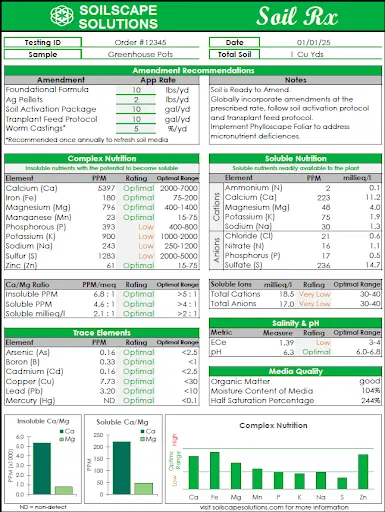
Decoding the raw data of a soil test is not always straightforward. Different labs use different extraction methods and benchmarks, and what's considered “optimal” can vary based on crop type.
That’s why using an interpretation tool or service is so helpful.
Helpful Tools:
1. The Soil Doctor
For just $50, you can upload your lab results to the Soil Doctor Online Tool, and they’ll analyze your test and provide tailored recommendations. This service is ideal for small farmers, gardeners, or cannabis cultivators who want a second opinion.
2. Soilscape Solutions
Soilscape offers soil test kits for specifically targeted towards cannabis growers and will analyze and archive your results in a cloud-based database. This continuity allows you to track your soil health year after year and optimize for consistent yields. Their team also specializes in organic and regenerative cultivation, making them a good fit for sustainability-focused operations.
Use code QUEEN for 10% off your order!
3. Local Agricultural Extension
You can contact your local agricultural extension office for the home grower interested in the data, but saving money. Each county typically works with a local university and offers free testing to home gardeners. This can be an excellent tool for home growers just starting to take soil testing seriously.
What About At-Home Test Kits?
Not everyone needs a full lab report, especially when just getting started. At-home soil test kits can be a great entry point into soil science. These kits test for NPK and pH using colour-change strips or chemical solutions. While they lack precision and detail, they can highlight obvious issues like nitrogen deficiency or a pH that’s out of range.
For example, the Luster Leaf Rapitest is widely available and easy to use. Digital soil meters can also provide quick pH and moisture readings, giving you some insight without sending samples to a lab. The Microbiometer can tell you your bacteria-to-fungi ratio and give you a snapshot of microbial activity in your soil. These tools are perfect for container growers, community gardens, or seasonal growers with short-term goals.
Check out this video of me using a micorbiometer!
The Role of pH, CEC, and SOM in Nutrient Uptake
Soil isn’t just about nutrients—it’s about how they interact with the environment. Let’s break down some of the most important supporting players.
pH
Soil pH affects nutrient availability. For cannabis and most vegetables, a pH of 6.2–6.8 is ideal. Outside that range, nutrients like phosphorus, iron, and manganese become locked out—even if they’re present.
CEC (Cation Exchange Capacity)
This measures the soil's ability to hold onto nutrients. A high CEC means your soil can retain nutrients well, reducing leaching and making your inputs more effective.
- Low CEC (<10): Nutrients may leach quickly. Use slow-release or frequent light applications.
- High CEC (>20): Soil holds nutrients better, but may require higher amendment doses to reach optimal levels.
SOM (Soil Organic Matter)
Organic matter feeds the soil biology, which helps cycle nutrients. It also improves structure and water retention. Aim for 3–6% SOM in most soil types.
If you haven’t already, check out our previous article onWhy Nutrient Availability Matters More Than Nutrient Quantity. In it, we dig deeper into how nutrients become plant-available and how to optimize them with compost, biology, and cover cropping.
Pro Tips for Better Soil Testing
- Always collect samples from multiple spots and mix them for a representative sample.
- Use clean, stainless steel tools and a non-metallic bucket.
- Don’t sample right after fertilising.
- Send your soil to the same lab consistently for apples-to-apples comparison over time.
Final Thoughts: Don't Guess, Soil Test
Soil testing might seem intimidating at first, but it empowers you to grow more successfully with fewer inputs. Over time, you’ll save money, reduce waste, and create healthier soil.
Whether you’re a home gardener, cannabis cultivator, or commercial grower, soil tests—especially when combined with expert interpretation—help you make better decisions. Use at-home kits for quick insights or lean on tools like the Soil Doctor or Soilscape Solutions for more in-depth support.
Remember, your soil is alive. Understanding it is the first step in cultivating plants and a thriving, sustainable ecosystem.