
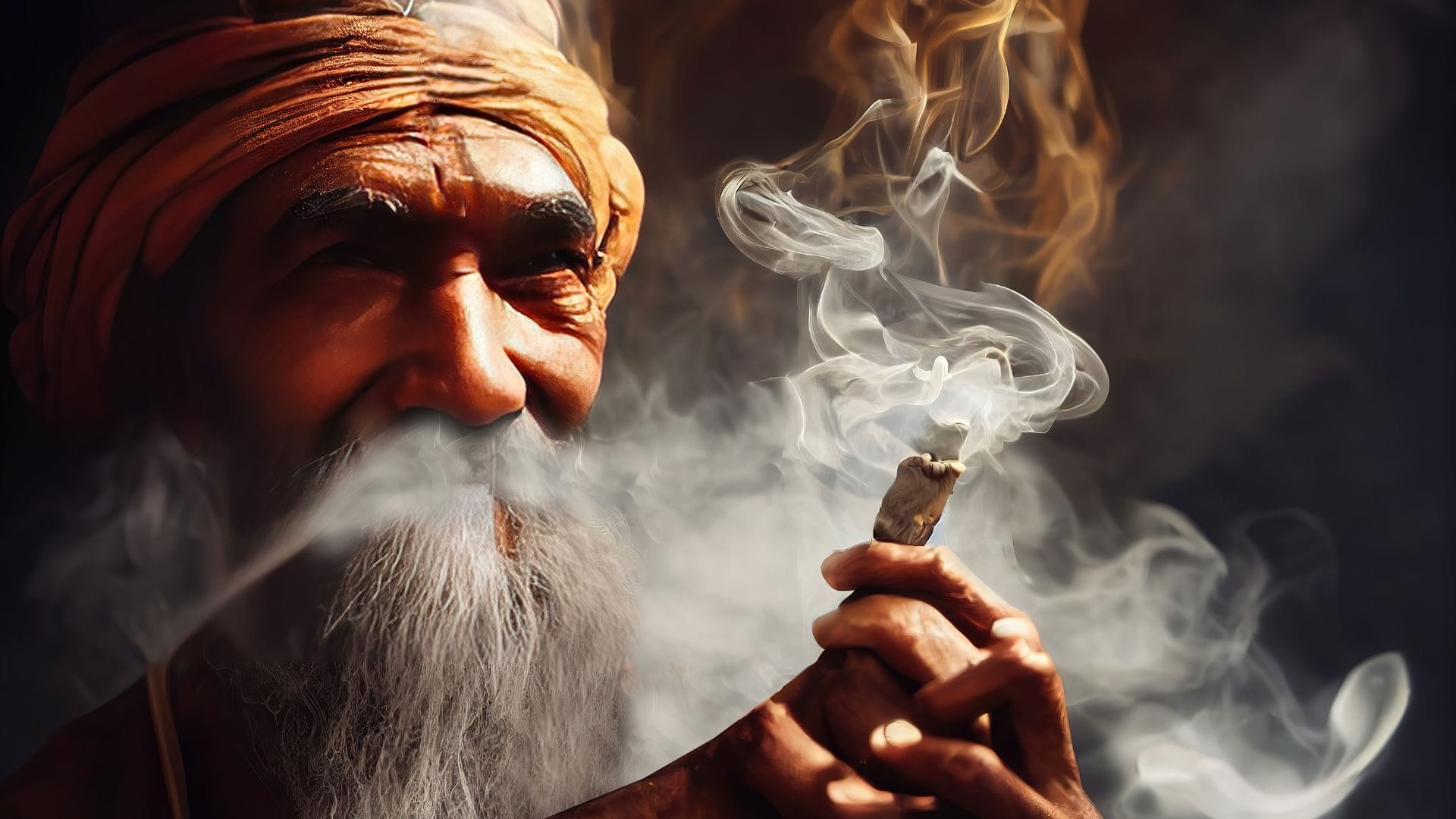

Cannabis can be eaten, drunk,vaped, applied as a tincture or a topical cream, or smoked. In this article, we look at the history of smoking and the devices that have been used and are still used to smoke cannabis.
The Earliest Reports Of Smoking Cannabis: In Tents
Excavations of several archaeological sites in Eastern Europe and Central Asia, dating from the 5th millennium BCE, have uncovered the remains of equipment used to smoke weed. Small tents made of felt were erected, supported by three or more sticks in a triangular shape. Inside, cannabis buds would be placed either directly on hot embers, or in censers, hung inside the tent, which had hot coals in them, on which buds would be placed. People would put their heads inside these small tents and inhale the smoke.[i] This practice persisted for many centuries.
People of the so-called Yamnaya culture, which flourished between around 3500 to 2500 BCE in the Pontic region of the Black Sea and on the Caspian steppes, and which eventually spanned 3,000 kilometres, from the Danube to the Urals, used censers, probably to inhale cannabis smoke.[ii]
Scythians And The Spread Of Cannabis
Between around 800 BCE and 300 CE, the Scythians, who were wild, horse-riding, nomadic warriors, created the world's first major empire, which stretched from Eastern Europe, through Central Asia to Western China (Beckwith 2023). The Scythians also smoked weed in felt tents. This was reported around 420 BCE at Olbia, on the Black Sea, by the Greek historian Herodotus in his Histories.[iii]
Cannabis, used for inebriation, has been found in leather baskets and wooden bowls at Scythian burial sites in the Xinjiang region of Western China, dating to the mid-1st millennium BCE.[iv] Interestingly, the English term 'cannabis' derives from the Greek word kánnabis, which, in turn, is a loan word from the Scythian language.[v]
Smoking Herbal Cigars As A Medical Treatment In India
Caraka, who around 2,000 years ago compiled one of the foundational works of Indian medicine (Āyurveda), prescribes the mixing of around two dozen dried and powdered plants—but not cannabis or tobacco—into a cigar-like pipe, which is then smoked (three puffs) eight times daily. This is said to relieve numerous ailments in the neck and head. Excessive smoking is said to lead to deafness, blindness, dumbness, giddiness and bleeding from different parts of the body.[vi]
Smoking any plant recreationally did not, however, become popular until the introduction of tobacco, which began in the 17th century.


The Discovery Of Tobacco
In the 16th century, the Italian traveller Girolamo Benzoni noted the use of tobacco was very common among the native inhabitants of Guatemala and Nicaragua. Dried tobacco was wrapped in a maize leaf and smoked: "And there are some who take so much of it, that they fall down as if they were dead, and remain the greater part of the day or night stupefied...what a pestiferous and wicked poison from the devil this must be...". In La Española and the other islands, when their doctors wanted to cure a sick man, they went to the place where they were to administer the smoke, and when he was thoroughly intoxicated by it, the cure was mostly effected".[vii]
These comments illustrate how uncured tobacco can have a very powerful effect, and also how it was used (and is still used) in folk medicine in many places. It has been discovered, however, that cannabis smoke is probably far less carcinogenic than the smoke of tobacco.[viii]
Tobacco Arrives In Europe
In an interesting quirk of history, tobacco has followed a somewhat similar trajectory to that of cannabis.
Tobacco was first introduced into Europe in 1560 by Francesco Hernandez, a Spanish physician who brought tobacco plants from Mexico to Spain for Phillip II. Around the same time, Jean Nicot (whose name was later used for 'nicotine'), the French Ambassador to Portugal, brought tobacco seeds, which had come from Florida, to Paris for the queen, Catherine de Medici. Cardinal Santa Croce subsequently introduced tobacco to Italy.
The first person to smoke tobacco in Britain, in 1556, was Ralph Lane, the Governor of Virginia. The tobacco plant was first brought to England by Sir John Hawkins (not Sir Walter Raleigh, who only later caused it to become fashionable). Hawkins brought a West Indian variety that was first noted in 1492, when two sailors sent ashore in Cuba by Columbus saw locals smoking it.
Spenser mentions "divine Tobacco" in his Faerie Queene (Book III, Canto V, vs. 32), first published in 1590. William Lilly, court poet to Elizabeth refers to "our holy herb nicotian" in his play The Woman in the Moone in 1597.
In Europe, Tobacco was known as 'Herba Panacea', 'Herba Santa', 'Herbe de la Reine' and 'Herbe Medicée', and in Germany as 'heilig Wundkraut'. At its inception, tobacco was considered to be a 'wonder drug'.[ix]
Smoking Tobacco In India And Iran
Recreational smoking of tobacco was only introduced—alongside pineapples and turkeys[x]—into India by the Portuguese around 1600 CE,[xi] during the reign of Akbar (1556–1605). Soon after its introduction, tobacco was mixed with cannabis and smoked together. This also happened in Iran around the same time.[xii] In India, weed or hash is still nearly always smoked with tobacco.

Pipes
There are, of course, many kinds of pipe for smoking, made from wood, metal, ceramic or clay. The earliest evidence of cannabis smoking comes from Africa, in Ethiopia, where traces of cannabis were found in the ceramic bowls of pipes dating to around 1320 CE.[xiii] However, this early date is not entirely certain.[xiv]
Cilam (chillum)
A cilam is a conical clay pipe that has a stone lodged inside to keep the mixture of weed (or caras/hash) and tobacco in the top of the pipe. The stone may be rough stone, or one specially fashioned for smoking efficiency. A damp cloth is wrapped around the end of the cilam, to cool the smoke and prevent bits of weed or tobacco or hot embers from passing through. The small, simple cilam, made of unfired red clay is still the usual way to smoke weed in rural South Asia. The origin of the cilam in India, in the 17th century, is that it was originally used to house the tobacco in the top of a water pipe, which first started being used in India around 1600 CE.

In the 1970s and 1980s in particular, some cilam enthusiasts went to great lengths to perfect it. The cilams were made of special clays, sometimes collected from Spain or Turkey, and the inside of the pipe would be as smooth as the barrel of a gun. The stones were long and grooved. The clay pipes and the 'stones' would be cooked to high temperatures, and occasionally tested by perfectionists for strength by dropping them onto a concrete floor, to see if they fractured or broke. The aim was to produce the smoothest, coolest smoke.
Makeshift cilams made from bottles, inverted, with the glass bottom removed, are also commonly used worldwide.
Water-Pipe
The Persian term 'huqqa' originally referred to a container of psychoactive drugs, but came to mean a water-pipe to smoke tobacco or cannabis.[xv] The hookah, as it became known, has a long flexible pipe, and a vessel containing water, through which the smoke passes and becomes cooled. Sometimes hot coals are placed in the bowl of the hookah, and then either tobacco or hash or a mixture is placed on top.
One version of the water-pipe is called a narghile/nargīl, where the water vessel is a coconut, with two holes: one for a pipe with a bowl on top (for the smoking mixture), and the other for a pipe to inhale the smoke. Water-pipes became popular in the 17th century; some are very elaborate and decorated.[xvi]

Two kinds of water pipe have been found in Africa: one with an angle between the bowl and the stem (or stem socket), also called 'elbow-bend pipes'; another kind has no bend and is known as a 'barrel pipe' or 'tube pipe'. The latter type is found in the eastern, southern and central areas of Africa. Many such pipes begin to appear in the archaeological record from around 1600 CE. Cannabis, which was probably used in Africa before tobacco, is almost exclusively smoked—not eaten—in Africa, and usually in water pipes.[xvii]
Joint And Blunt
Joints are sometimes made in Asia and elsewhere by emptying out a cigarette, mixing the tobacco with weed or hash, and then refilling the cigarette. Rolling papers for smoking tobacco—and, later, cannabis—were first produced in Alcoy, Spain, in 1764.[xviii] Blunts are hollow-out cigars or cigarillos that are filled with weed instead of tobacco.
Bong
The term 'bong' derives from the Thai word 'baung', which is traditionally a water pipe made from a bamboo cylinder, with water inside and a bowl on a pipe inserted into the cylinder. This way of smoking is common in several regions of Africa, and also in Thailand, Laos and Cambodia.

Earth Pipe
In Africa, another traditional method of smoking in some cultures is the earth pipe.[xix] The smoking material (weed, tobacco or other plants such as Datura metel) is placed in a hole in the ground, and a bamboo pipe is pushed through the earth into the earth 'bowl', and used to inhale the smoke.
_______________________________________________________________________________________
References
Beckwith, Christopher I. (2023). The Scythian Empire: Central Eurasia and the Birth of the Classical Age from Persia to China. Princeton/Oxford: Princeton University Press.
Benzoni, Girolamo (trans. and ed. W. H. Smyth) (1857). History of the New World, Shewing his Travels in America, from A.D 1541 to 1556: with some Particulars of the Island of Canary. London: The Hakluyt Society.
Blochman, H. (1872). 'Query 6—about Tobacco'. The Indian Antiquary, vo1. 1, 3rd May, p. 164.
Caraka (trans. and eds. Ram Karan Sharma and Vaidya Bhagwan Dash) (1983). Agniveśa's Caraka Saṃhitā (Text with English Translation and Critical Exposition Based on Cakrapāṇidatta's Āyurveda Dīpikā) (Chowkhamba Sanskrit Studies, vol. XCIV), vols. 1–2. Varanasi: Chowkhamba Sanskrit Series Office.
Graves, Charles (1969). A Pipe Smoker's Guide. London: Icon Books Limited.
Herodotus (trans. and intro. Aubrey de Sélincourt) (19680 [1954]. The Histories. Harmondsworth, Middlesex: Penguin Books.
Indian Tobacco: A Monograph (1960). Madras: Indian Central Tobacco Committee
(Ministry of Food and Agriculture, Government of India.
Jiang, Hong-En, Xiao Li, You-Xing Zhao, David K. Ferguson, Francis Hueber, Subir Bera, Yu-Fei Wang, Liang-Chen Zhao, Chang-Jiang Liu, and Chang-Sen Li (2006). 'A new insight into Cannabis sativa (Cannabaceae) utilization from 2,500-year-old Yanghai Tombs, Xinjiang, China'. Journal of Ethnopharmacology, vol. 108, pp. 414–422.
Kazemi, Ranin (2020). 'Doctoring the Body and Exciting the Soul: Drugs and consumer
culture in medieval and early modern Iran'. Modern Asian Studies, vol. 54, issue 2
(March), pp. 554–617.
Melamede, Robert (2005). 'Cannabis and tobacco smoke are not equally carcinogenic'. Harm Reduction Journal, vol. 2:21, pp. 1–4.
van der Merwe, Niklaus J. (1975) ‘Cannabis Smoking in 13th–14th Century: Chemical Evidence’. In Vera Rubin (ed.), Cannabis and Culture, pp. 77–80. The Hague/Paris: Mouton Publishers.
Parpola, Asko (2015). The Roots of Hinduism: The Early Aryans and the Indus Civilization. Oxford/New York: Oxford University Press.
Philips, John Edward (1983). 'African Smoking in Pipes'. Journal of African History, vol. 24, pp. 303–319.
Pritchett, Robert T. (2015) [1890]. Smokiana: Historical, Ethnographical. Istanbul: e-Kitab
Projesi & Cheapest Books.
Sherratt, Andrew (1991). 'Sacred and Profane Substances: The Ritual Use of Narcotics in Later Neolithic Europe'. In P. Garwood, D. Jennings, E. Skeates, and J. Toms (eds.), Sacred and Profane: Proceedings of a Conference on Archaeology, Ritual and Religion, Oxford, 1989 (Monograph no. 32). pp. 50–64. Oxford: Oxford Committee for Archaeology.
Sherratt, Andrew (1995). 'Alcohol and its Alternatives: Symbol and Substance in Pre-Industrial Cultures'. In Jordan Goodman, Paul E. Lovejoy, and Andrew Sherratt (eds.), Consuming Habits: Drugs in History and Anthropology, pp. 11–46. London/New York: Routledge.
Wikipedia (2023). 'Rolling Paper'. https://en.wikipedia.org/wiki/Rolling_paper
Witzel, Michael (1999). 'Early Sources for South Asian Substrate Languages'. Mother Tongue, Special Issue, October, pp. 1–76.
__________________________________________________________________________
[i] (Sherratt 1991; 1995:27).
[ii] (Parpola 2015:53).
[iii] (1968:265–266).
[iv] (Jiang et al. 2006).
[v] (Witzel 1999:65).
[vi] (Sūtrasthāna 5.20–55).
[vii] (Benzoni 1857:81).
[viii] (Melamede 2005).
[ix] (Graves 1969:7–10).
[x] (Blochman 1872:164).
[xi] (Indian Tobacco 1960:1).
[xii] (Kazemi 2019:603).
[xiii] (van der Merwe 1975).
[xiv] (Philips 1983:313).
[xv] (Kazemi 2019:596).
[xvi] (see Pritchett 2015).
[xvii] (Philips 1983:304–307).
[xviii] (Wikipedia 2023).
[xix] (Philips 1983:305).