

The further into the legal era of cannabis we get, the deeper our knowledge and understanding becomes. This means what was once a privileged and rare piece of expertise becomes more common and applied by the wider growing community. VPD is commonly monitored in professional horticultural and is a key metric to keep plants performing optimally. It's also something home growers are tracking a lot more, and some find VPD to be an instrumental data point for maintaining healthy plants throughout the grow. Here, we look at understanding Vapor Pressure Deficit.
VPD: What Does It Stand For, And What Does It Mean?
Vapor Pressure Deficit (VPD) is as much as it sounds; it's a measurement of pressure based on environmental monitoring that calculates the difference between the amount of moisture in the air and how much moisture the air can hold when it is saturated, i.e. before it condenses at a given temperature. The moisture in the air affects the pressure and correlates with the plants' ability to transpire (release water via the leaves). A combination of temperature and humidity determines VPD to provide a reading in pressure, which shows how close or far away the environment is from having water condense on the plants. The pressure that the moisture in the air creates versus the plants' ability to transpire effectively in those conditions is the VPD. In terms of the effect on the plants themselves, it influences transpiration rates, which in turn affects the nutrient and water uptake, the ability of the plant to cool itself, and generally maintain good overall health.

How Vapor Pressure Deficit Works
To better understand VPD, a few more familiar readings are important - for example, the relationship between the temperature in the environment and the temperature of the plant's leaves. Another is the relative humidity (RH) levels in the growing environment. The temperature obviously determines this, so moisture and the temperature are very tightly correlated, and this also determines the saturation vapour pressure, or SVP, which is the most water vapour that air can hold at the temperature in question. These factors are used to calculate the pressure in kilopascals (kPa). When VPD is low, counterintuitively, the air is almost at full saturation with water. This creates a low-pressure differential that reduces transpiration and potentially causes a reduction in water and nutrient uptake. It typically creates good conditions for plant pathogens such as mold and bacteria to take hold.
On the other side of the scale, when the VPD is high, this means there is little moisture in the air, and the result is high pressure, usually in a dry environment, increasing transpiration. This causes increased water uptake by the roots as the plants' transpiration rate increases. If this gets excessively progressive, it can cause water stress to plants as they close their stomata to conserve water, causing excess nutrient uptake and ultimately creating an extremely inefficient water balance. If this coincides with root mass drying, the plant will show signs of stress quickly. Therefore, maintaining or at least keeping an eye on VPD is essential. Although temperature and RH can be monitored to an extent, the VPD is a solid metric for understanding plant health, especially if the conditions are not optimal.
Controlling Vapor Pressure Deficit
Given the relationship of VPD with temperature and RH, controlling these aspects of the plant's environment is critical to controlling VPD. For example, as the temperature drops when the lights go off, the RH tends to go up, and the VPD goes down, meaning the moisture in the air is getting closer to the point of condensing, which will reduce transpiration. To manage VPD effectively, control of temperature and humidity, especially during the transition from higher to lower temperatures, is key. Heaters, air conditioners, and inlet and outlet fans help maintain the target temperature as humidifiers and dehumidifiers maintain target humidity levels.

One aspect that is often overlooked is monitoring equipment. It's best to use hygrometers and thermometers that continuously monitor RH, temperature, and VPD, preferably with remote access, to check this on a smartphone from anywhere. There are also online calculators or charts to help determine the ideal VPD for the specific conditions of any environment, should monitoring equipment be limited to temperatures and RH. Avoiding the dew point, which is the temperature at which moisture in the air condenses and, for example, causes dew on plants, is crucial. Monitoring, or at least avoiding the dew point, helps prevent mold and mildew. Keep the temperature above the dew point at all times, and monitor the environment 24/7 to ensure there is no point in the day/night cycle where conditions become unfavourable.
Equipment To Help Control Vapor Pressure Deficit
Devices like the AC Infinity Controller work great to automate the system, synchronizing the fans, humidifiers, dehumidifiers, etc., to maintain stable conditions. This is very important as it takes the stress out of manually adjusting and changing things to suit the current conditions, only to find they drift out over the next hour or so. Anything that can automate this part of the growing is generally a big help.
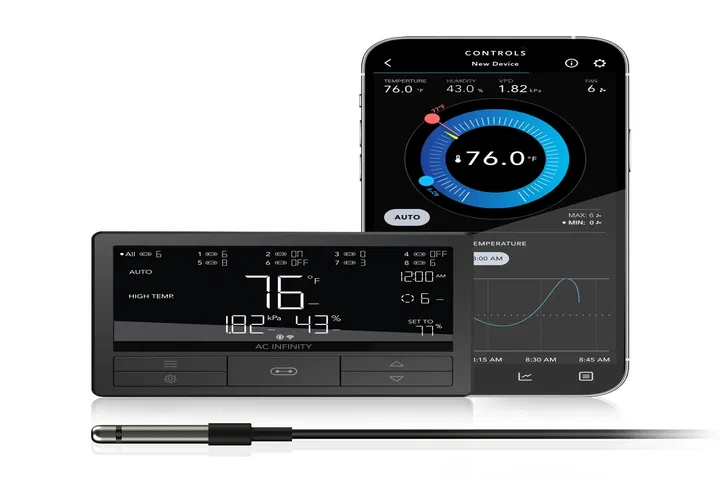
Just watch out for controllers that prioritise RH over temperatures, as this can cause cooling loops and all sorts of strange behaviour if the setpoint cannot be easily reached. Proper ventilation is critical in any grow. Therefore, the use of high-quality fans to help manage air exchange and reduce excess humidity and heat efficiently is recommended.
VPD Sensors and Set Points
For relatively modest costs, a remotely accessible hygrometer, which can provide real-time VPD readings, can be purchased to monitor the growing environment from a smartphone. VPD sensors are more expensive and precise than hygrometers, which calculate the VPD based on its temperature and RH readings. A VPD sensor does something similar, but the difference is they tend to use better components. As they are less in demand to the public, they are therefore not made in mass for a cheap RRP as many hygrometers are. Otherwise, a few calculations, which you can do online using RH and temperature, will provide the VPD range.

Although ranges may vary depending on the variety of plant, typical safe VPD ranges are as follows:
Germination: VPD of 0.45-0.75 kPa
Vegetation: VPD of 0.75-1.25 kPa
Flowering: VPD of 1.25-1.75 kPa
Conclusion
Maintaining the correct Vapor Pressure Deficit throughout the cannabis lifecycle can work wonders in the mitigation of problems. Monitoring and adjusting temperature and humidity, especially if automated, allows growers to create an ideal environment that promotes optimal plant water use. This means understanding and managing Vapor Pressure Deficit can significantly enhance the quality and quantity of a cannabis harvest. Furthermore, making smart choices on the hygrometer purchased will generally mean that VPD and dew point are tracked along with temperature and relative humidity. Doing so takes a lot of the need to understand VPD out of the equation, as staying within the ranges for each life stage is all that is required. You can do this through temperature and humidity control. VPD is an increasingly valued metric for growers, especially those with issues they cannot otherwise solve, such as nutrient excess, lack of water uptake and even seemingly random outbreaks of pathogens. Make sure VPD is monitored parameter of the growing environment to ensure the plant has every chance of reaching its potential.