How to grow cannabis from seed is a question that we’re often asked, and it’s one that requires a lengthy answer. Although there might not be a number one best way to grow weed, there are common practices and tips that most successful growers follow to get their plants from seed to harvest.
If you want to grow your own weed, you’re certainly in the right place, because right now we’re going to do a growing weed 101 crash course, to provide you with all of the best pieces of information you need for growing cannabis from seed. In this article you’ll learn how to grow cannabis indoors at home, using soil and synthetic nutrients.
Growing Weed 101: How to Grow Cannabis from Seed
As you’re about to see, there are seven simple steps involved in growing your own cannabis, and it all starts with collecting all of the equipment and tools required, so let’s start there.
Step 1: Equipment You’ll Need to Grow Your Own Weed
First of all, there are a few different pieces of equipment that you'll need to grow cannabis from seed. Let's take a look at the main ones.
Grow Lights
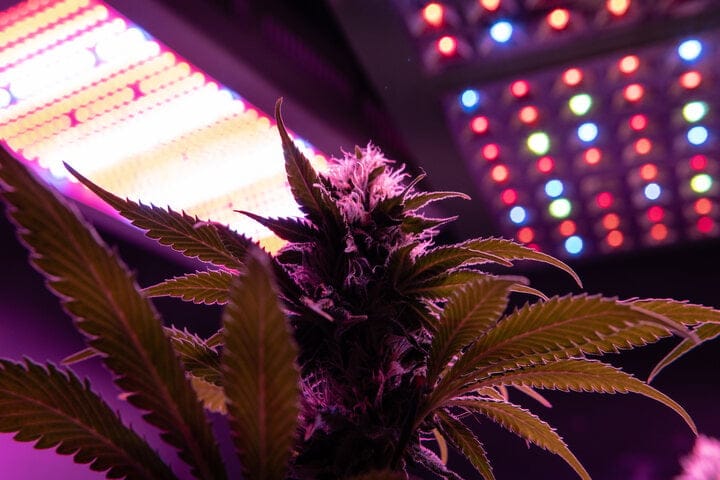
All cannabis plants need light, and this means that you need grow lights when growing indoors. There are serval options out there but full-spectrum LED grow lights are the most popular option. This type of grow light provides your plants with the full spectrum that they need to grow, they don't produce much heat, they are energy efficient, and cost effective as well.
A Grow Tent
If you are growing your weed from seed indoors, then a grow tent is something else that you want to consider.
Although a grow tent may not be 100% necessary, it provides you with an enclosed space where you can easily control the environment, so you can maintain light cycles, humidity, and temperature as needed.
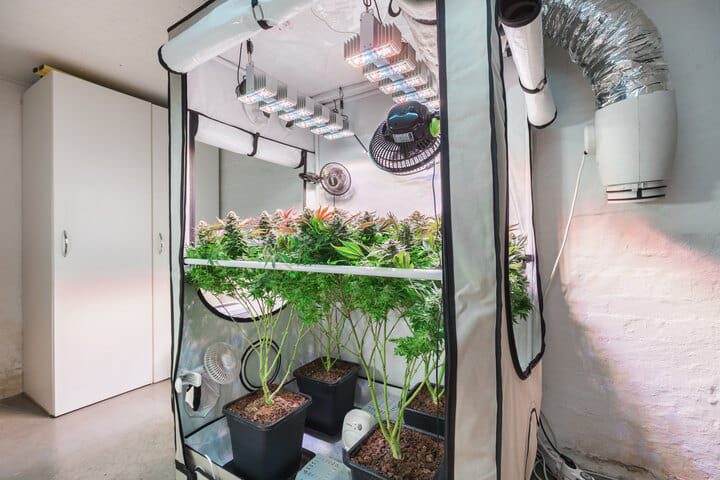
As you'll see further below, these are all important factors that play into the success of your cannabis plants.
Ventilation
Something else you'll need if growing indoors is a ventilation system. Now, you could just use a regular fan to blow some air around the grow tent, but that's likely not good enough.
To ensure proper air exchange, you'll want to install an inline fan along with a carbon filter. An inline fan will help draw fresh air into your grow tent, and the carbon filter will prevent the air being exhausted from smelling like weed.
Growing Medium and Pots
What you're going to need next are the pots that you're going to plant your weed in. To grow weed from seed, many growers start with very small seedling trays, followed by much larger pots.
For the final growth stage, we recommend going for 5-gallon pots if using synthetic nutrients. These final containers should have more than enough room for your cannabis plants. In terms of the growing medium, a high-quality potting soil with a balanced nutrient blend is generally recommended.
pH Meters and Nutrients
Although the soil you purchased should have enough nutrients to keep your cannabis plants going for some time, they will eventually require more.
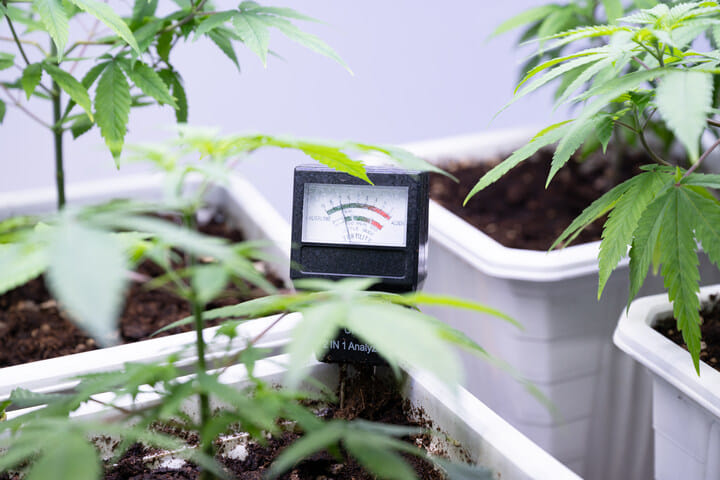
Therefore, you'll want to buy the proper nutrients for both the vegetative and flowering stages of growth. You could also gain value in getting a pH meter to keep track of the pH level.
And More
Quite honestly, there are many other pieces of equipment that you could purchase to grow your own cannabis from seed. Just a few things that you might need include: pruning shears, trellis nets, timers, thermometers, hygrometers, spray bottles, and more.
Step 2: Seeds
With all of your equipment gathered, the next step is to get cannabis seeds. Of course, if we're talking about growing weed from seed, then you first need to find the right ones for your needs.
The fact of the matter is that there are actually different kinds of cannabis seeds you can purchase, so let's take a closer look.
Different Types of Cannabis Seeds
First of all, we have the most cost-effective type of cannabis seed, the regular cannabis seed. These can grow into either female or male plants, which can be a problem because you need to identify the male plants and remove them to avoid pollinating the female plants.
We then have feminized seeds, which are seeds that have been specially bred to only produce female plants. This is very convenient because it means that you never have to deal with male plants growing, and you won't ever have to sex your cannabis plants either. They'll all turn out as females.

The final type of seed you can go for is the autoflowering seed, or to be specific, feminized autoflowering seeds. These are specially engineered to automatically transition from vegetative to flowering without any need for a change in light cycle. These are ideal for growing in lower light conditions, for smaller areas, and they have a shorter growth cycle as well.
How to Germinate Cannabis Seeds
Once you've chosen your cannabis seeds, the next step is to germinate them. When it comes to how to grow weed at home, how to germinate cannabis seeds is one of the questions that we get asked the most. Well, there are several common methods of doing so, including direct planting, soaking in water, and the paper towel method.
We personally recommend the paper towel method, as it allows you to see if the seed is viable faster than direct planting. To germinate your cannabis seeds using a paper towel, simply put the seeds in between a few layers of moist paper towels. The paper towels should be moist, but not soaking wet.

The seeds need water in order to germinate. You should now put the seeds that are inside of the wet paper towel into a plastic bag that you can seal, which helps maintain the moisture. Keep them in a dark and warm spot, and check them daily. They should sprout in no more than 72 hours.
How to Plant Cannabis Seeds
Once your cannabis seeds have germinated and the tap root is visible, it's time to plant them. This means that you first need to prepare your growing medium. For this purpose, you can use either starter plugs or small pots. They should be filled with well-draining soil.
Make sure that the medium is already moist, with the pH adjusted to anywhere between 6.0 and 7.0. To plant the cannabis seed, make a small hole about 1/4 inch in depth, and then place the seed facing down, or in other words, the small taproot that grows out of the seed should be placed facing downwards.
Very gently cover the seed with soil, but don't tap it down too hard, or else you might damage the taproot. Lightly spray the top of the medium until it is moist. Until the seedling emerges from the ground, it will not require any light.
Step 3: Create an Ideal Environment for the Best Way to Grow Weed
With your cannabis seeds planted, the next step is to create an ideal environment for them to grow in.
Now, exactly what temperature and humidity your plants need is determined by the stage of growth they are in; that's something we will address in this step.
Lighting
Your cannabis plants need light to engage in photosynthesis. Get an LED grow light that can produce at least 30 watts of energy per square foot.
You should keep them about 12 to 18 inches above the canopy, or else you might burn the plants. However, every LED grow light is different so check the manufacturer’s recommendation to get a more accurate answer. During the vegetative stage, your cannabis plants need anywhere between 18 and 24 hours of light per day, and just 12 hours during the flowering stage.
Temperature
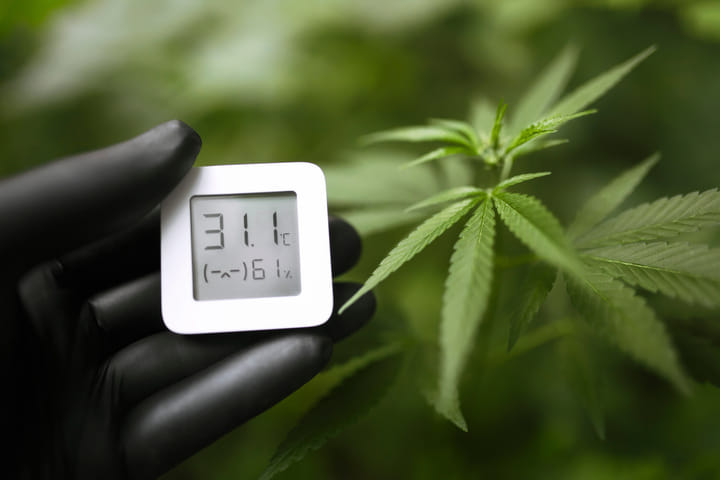
To grow your own weed at home, you also need to maintain proper temperatures. Generally speaking, the temperature in your grow room should be between 70° and 85°F, or between 20° and 30°C. This is a wide range and somewhere in the middle of that range is generally best.
Relative Humidity
When growing weed from seed, humidity matters as well, especially when it comes to preventing stress, pests, and mold. During the vegetative stage, the general range for relative humidity is between 45% and 65%, and between 40% and 60% during the flowering stage. Again, this is a very wide range. To get the most optimal growth, investigate the Vapor Pressure Deficit (VPD) ranges for plants. You can always use air conditioners, heaters, fans, dehumidifiers, and humidifiers as needed to control the environment conditions.
CO2
Although it's not 100% necessary to supplement CO2, cannabis plants can always benefit from a bit of additional CO2 being pumped into the grow room.
This will help enhance both growth and your overall yield. However, keep in mind that CO2 should only be used during those times when your plants are receiving light.
Air Circulation
Your plants are also going to need a good bit of ventilation and air flow. Air flow helps to strengthen plants and it reduces the risk of mold. Using an inline fan is helpful here, but having two or more oscillating fans in your grow space will help ensure proper air circulation as well.
Step 4: Vegetation Stage
With you having created the proper environment for growing weed, it's time to move on to the next step.
Some growers consider the seedling stage (first 2-3 weeks after sprout) part of the vegetation stage while others mark it as a different stage of the plant’s life. Either way, the vegetation stage is where it gains a lot of its height and width, and when it develops foliage.
Transplanting
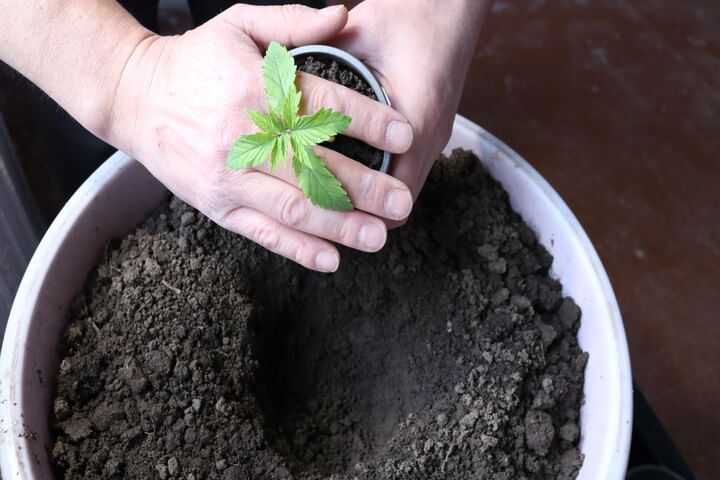
After a few weeks in its starter pot, you should see the plant’s leaves grow past the edges of the grow pot. That is a sign that it is time to transplant it to a bigger container.
Once it's time to transplant, transplant the seedlings into larger, 5-gallon grow pots, although some growers opt for 3-gallon grow pots instead. To reduce stress, give your plant a bit of water before transplanting and sprinkle some mycorrhizal fungi onto the roots before placing into its new container.
The Light Cycle
During the vegetative stage, you need to consider the light cycle. Most growers would recommend providing a plant in the vegetative stage with 18 hours of light and 6 hours of dark, although to promote continuous growth, you can provide your plant with 24 hours of light per day.
However, if you provide your plant with 24 hours of light per day, make sure that your grow lights are the proper distance to ensure it doesn’t exceed its daily lighting integral (DLI), or else you might cause light stress.
Watering
When it comes to the best way to grow weed, one of the most important things you need to master is watering. Your cannabis plants need water to prevent dehydration, but it also helps ensure that nutrients are readily available. Whenever the top inch of the soil feels very dry, that’s a general sign that you can water your cannabis plants.
Make sure to water your cannabis plants evenly around the base so that the roots spread. Furthermore, make sure that you use water that has been pH adjusted, anywhere between 6.0 and 7.0 pH for soil. This will help maximize nutrient absorption.
Make sure to not overwater your cannabis plants, as this can lead to root rot, nutrient lockout, and the death of your plants. If you notice that your plants start to droop within a day or two of watering, that’s a sign that you've given them too much.
Plant Training
If you want to manage the shape of your plant, increase bud sites, and produce higher yields, then now is the time to engage in training.
There are various types of cannabis plant training techniques you can use, including low stress training, topping, and super cropping, as well as creating either a sea of green or screen of green. Each of these methods has its pros and cons, so we recommend doing a bit of research.
Step 5: Flowering Stage
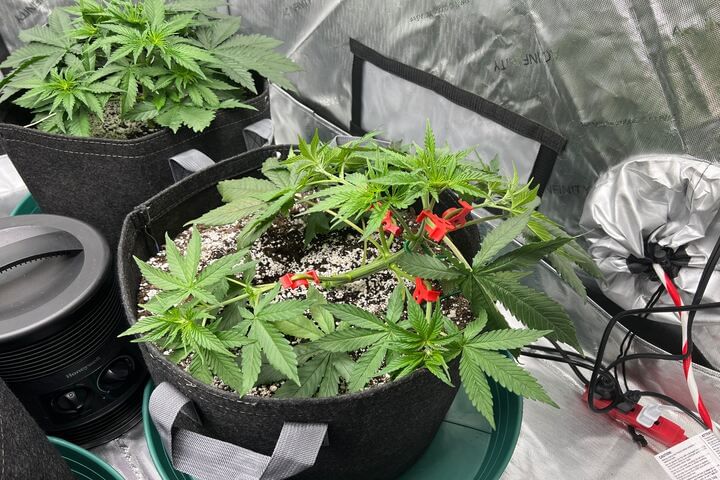
The vegetative growth cycle of a cannabis plant can last anywhere between 3 and 16 weeks, depending on how long the grower wishes to keep their plant in that stage of growth. After that, your cannabis plant should transition to its flowering stage, but not on its own.
Remember, only autoflowering seeds are designed to automatically transition to the flowering stage. If you don't have auto flowering seeds, you'll have to force this change yourself by changing the light cycle.
Light Cycle
To cause a cannabis plant to go from its vegetative stage to its flowering stage, you need to reduce the amount of light it gets. This is because in nature, less light means that it's getting closer to the fall season, and that spurs cannabis plants on to reproduce.
They know that their life is coming to an end, so they do what they can to reproduce. Which as far as female cannabis plants are concerned, means producing flowers, or those tasty buds that we all love.
Therefore, you need to reduce the amount of light your cannabis plants get to 12 hours, providing them with a balanced 12 hours of light and 12 hours of dark per day (12/12). There are other flowering light cycles such as 11 hours of light and 13 hours of dark per day or 10 hours of light and 14 hours of dark per day, but the most common is the 12/12 light cycle.
Sexing Cannabis Plants
Earlier in the article we recommended purchasing feminized cannabis seeds, because that means that all of your plants will grow to be females. If you don't buy feminized cannabis seeds, you will have to sex your cannabis plants once they start flowering. If you leave male plants in with the females, the pollen from the male plants will pollinate the females, which causes the female plants to grow seeds within their buds.
If you don't have feminized seeds, starting at about one week after switching to the flowering light cycle, you'll see that females develop small white hairs whereas male plants develop small round balls known as pollen sacs. Any male plants should be immediately removed.

Additional Tips on How to Grow Cannabis Plants During Flowering
For the best success when growing your own weed at home, you should cut back on nitrogen during the flowering stage. Also, make sure to provide your plants with plenty of phosphorus and potassium during the flowering stage. This should be reflected on the feeding chart of the nutrient lineup that you are using.
Furthermore, humidity should also be reduced to a maximum of 60% during this stage, and to safe side things, the highest temperature you should aim for should not exceed 80°F/26°C.
Step 6: Harvest
Cannabis plants can stay in their flowering stage from anywhere between 7 and 16 weeks, so it is important that you are familiar with what cannabis plants look like when they are ready to harvest. You don't want to wait too long to harvest, because that can decrease the integrity of the buds, but not being patient isn't ideal either. Let's talk about how to harvest your cannabis plants.
Harvest
Examine your cannabis plants very closely to identify when it's time to harvest. First and foremost, you want to examine the trichomes. When they turn to milky white from their original clear, it's an indication that your plants are ready to harvest. Some trichomes become amber which is the stage after milky white.
Moreover, the pistils on your cannabis plants should turn orange or brown. When about 90% of the pistils are dark, that’s a sign that your plant is ready. The buds should also be big, swollen, covered in sticky resin, and smelly.
To harvest your cannabis plants, use very clean pruning shears to cut the branches away from the stems. You can also trim away the larger fan leaves to cut back on moisture.
Drying
Once your cannabis plants are all cut down, it's time to dry them. To dry your cannabis plants, hang the branches upside down in a room that is dark and has great circulation. The humidity should not exceed 60%, and temperature should be anywhere between 55°F/13°C and 65°F/18°C – with 60°F/15°C being the sweet spot.
Once the stems snap instead of bending, it means that the buds are ready, and this generally takes 7-10 days. Just avoid having air blowing directly on the buds, as this will over-dry them.
Curing
The final step here is to cure your cannabis. This helps break down chlorophyll which enhances its flavor, and makes it much smoother to smoke as well. You'll want to take your dried weed buds and put them in airtight containers, preferably glass jars.
Only fill them to about 75%, and then store them in a dark and cool place at temperatures no higher than 65°F/18°C.
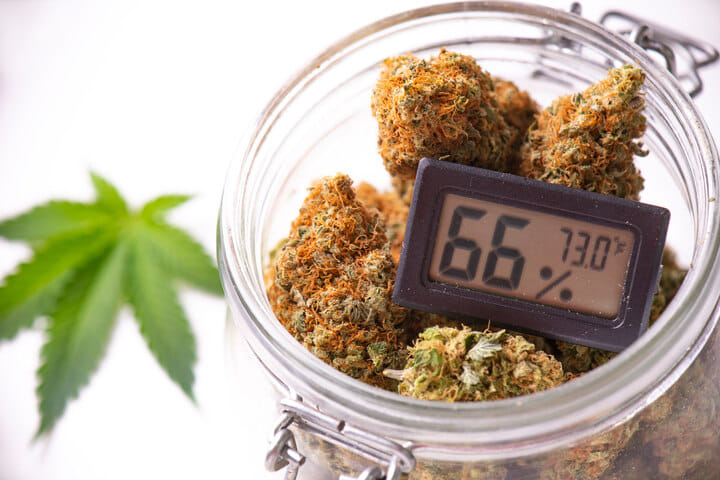
You'll also want to maintain a humidity level of about 60% within the containers. For the first two weeks, open the jars once a day to release gasses and moisture. Cure your weed for at least two to four weeks, although some go for up-to six months for the best results.
Step 7: Dealing with Problems
All throughout the growth cycle, there are a several problems that you could face. Let’s cover some of the common ones.
Overwatering and Underwatering
If you're overwatering your cannabis plants, you might see that the leaves are drooping, along with very wet soil. If you're underwatering your cannabis plants, they will also droop, but you may notice very brittle and dry leaves, with soil that is so dry that it pulls away from the pot.
The best method here is to always put your finger down into the pot anywhere between one and two inches. If the soil is bone dry, then it's time to water.
Heat Stress
Another problem your cannabis plants might be faced with is heat stress, which you'll notice because the leaves become brown or yellow, have a burned look, and will curl upwards. If you notice this happening, make sure that the temperatures are between 70°F/20°C and 85°F/30°C. If you need to, increase the speed of your inline fan to exhaust that hot air and/or move your plants further away from your grow lights. If that doesn’t work, add an air conditioner to your grow room.

Light Burn
Speaking of light, your cannabis plants can develop light burn, particularly if your lights are either too powerful or if you have them too close to your plants. Check the manufacturer’s recommended light distance and dim settings to ensure you aren’t giving them so much light that they get light burn.
Fungus Gnats
If you notice small black flies flying around the soil, they are likely fungus gnats. If you have a fungus gnat infestation, let the top layer of the soil dry out completely so that the gnats cannot properly breed. You should combine this with sticky traps to catch the adults.
Nitrogen Deficiency
One of the most common problems that your cannabis plants might be faced with is a nitrogen deficiency, particularly during the vegetative stage, which is when they need a lot of it.
If you notice that the older leaves at the bottom of the plant start to turn yellow, and the plant grows slowly, then you likely have a nitrogen deficiency. If so, the simple solution is to use a nitrogen-rich fertilizer.
Nutrient Burn
If you notice that your cannabis plants are developing burnt tips on the leaves, then there is a good chance that you've given your plants too many nutrients.
If you think that this is the case, stop giving them nutrients for about a week and only give them water. Nutrient burn can be a result of various nutrients being supplied to your cannabis plants in overabundance, whether nitrogen, potassium, phosphorus, or anything in between.
How to Grow Cannabis Seeds: Final Thoughts
As you can see, the steps to growing weed aren’t very difficult. Yes, there may be plenty of them, but if you follow all of the tips we’ve provided you with today, you can go from seed to harvest with success. For more details on all 7 steps, check out my book 7 Steps To Grow Cannabis. It’s a complete beginner’s guide to growing cannabis indoors. You can get it on my website, or on Amazon. Happy growing!