

There's still time to bag a great deal on Autoflowering seeds this May. Hop over to our promotions page for more details, then shop for bargains galore!
Autoflowering cannabis varieties are a class of cannabis which have the ability to flower independently of light cycle changes. These plants have evolved to flower at a certain point in their lifecycle rather than by external cues such as light duration. But how are these varieties created? How do you get an auto-version of OG Kush, for example? Well, the underlying genetic principles involved, and the implications of specific genetic mutations on flowering behaviours, will help answer these questions and more as we look at how autoflowering cannabis is made!
The Basis of Autoflowering Traits
Autoflowering traits in cannabis are primarily introduced by crossing non-autoflowering plants (usually of the subspecies sativa or indica) with a lesser-known subspecies called Cannabis ruderalis. The ruderalis subspecies will naturally flower based on its age rather than light exposure. This is a genetic trait which has recently been identified and showed that autoflowering is governed by natural genetic mutations. There may be other ways in which mutations can result in autoflowering, but they largely remain illusive. Through selective breeding, the autoflowering trait can be bred into the genetic makeup of the more commonly cultivated cannabis subspecies, indica and sativa. This means that through the proper practises, autoflowering traits can be ‘stolen’ from ruderalis and then expressed in an indica or sativa rendering it also autoflowering. Thus the creation of the auto!
Lowryder: The First Of Its Class
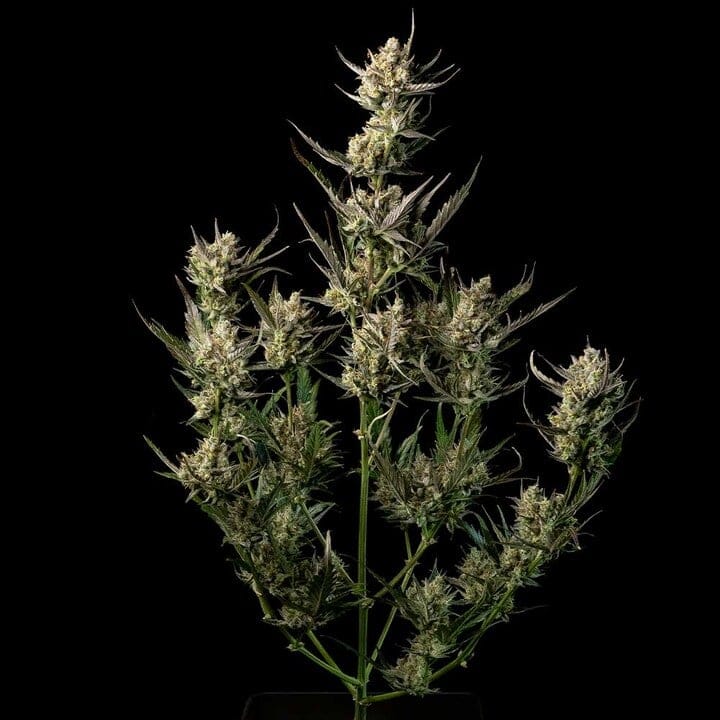
Props to the Joint Doctor, AKA Sasha Ivanov, who was the first to make this cross when he created the famous Lowryder variety in the early 2000s. Lowryder was developed by crossing a ruderalis with Northern Lights #2 and then later with a variety called William’s Wonder. The ruderalis carried the autoflowering trait to Lowryder, which meant the plant had the ability to flower automatically after a few weeks of vegetative growth, regardless of the light schedule. Lowryder was popular for stealth and small-scale grows. Plants were compact in size, displayed a quick turnaround, typically finishing their lifecycle in about 8-10 weeks from seed. This meant growers could have continuous harvests, which was important for growers in non-traditional cannabis growing environments, with short seasons, or where the plants had to be kept small and out of sight.
A Traditional Genetics Perspective
This is a little bit long-winded, but for those with an interest, here is how the genetic formula for autoflowering crossing works: Taken from a Mendelian genetics standpoint, let’s call the autoflowering trait (A), and let’s say that this trait is dominant over the non-autoflowering trait which we call (a). Remember that cannabis is diploid and therefore has two copies of every gene. When crossing a homozygous non-autoflowering plant (i.e. aa) with a homozygous autoflowering ruderalis (i.e. AA), the resulting seeds are in the F1 generation of all heterozygous autoflowering plants (Aa). Since (A) is dominant over (a), this means one copy of that gene is enough to have the trait, i.e. all F1’s will autoflower. When these F1 plants are interbred, F1 x F1, the resulting F2 generation follows a typical Mendelian 3:1 ratio where approximately 75% of the offspring exhibit autoflowering traits (AA, Aa) and 25% do not (aa). Remember, only one copy is needed for the trait.
Relationship Between Autos And Fasts
However, things are rarely this straightforward in genetics and there can be a type of ‘dose’ effect, where the mutation, even on the same gene, can be different and therefore affect the characteristic on a spectrum rather than an on/off, binary type of way. Crossing autoflowering plants with photoperiod-dependent strains can result in what are termed 'fast' or ‘quick’ flowering phenotypes. These plants have an intermediate flowering state that is neither strictly age-dependent, nor entirely light cycle-dependent like their photoperiod cousins. This variation results from incomplete dominance or co-dominance of the autoflowering gene, leading to a blend of the two flowering behaviours.
In this case, two (aa) still results in the autoflowering trait as before, and (AA) results in photoperiod as before, but the homozygous (Aa) will be photoperiod but usually with a faster flowering time or a faster initiation of flowering onset, than its (AA) counterpart. In this case, crossing the (AA) with the (aa) will result in the fast flowering in all (Aa) progeny. Therefore the resulting F2 cross (Aa x Aa) will work out in a ratio of 1:2:1, where 25% are autoflower, 50% are ‘Fasts’ and 25% are full photoperiod. This means depending on the type of mutation, and in which of the autoflowering genes it affects, there maybe one or the other outcome from the resulting cross.
Impact of Circadian Clock Genes on Flowering
Research has identified significant differences in gene expression between autoflowering and photoperiod plants during vegetative growth. Over 2,800 genes are differentially expressed between autoflowering and non-autoflowering cannabis, and that’s during the vegetative state. Specifically, the malfunction or ‘truncation’ of genes in the circadian clock have been linked to the autoflowering phenotype. A research team from Aurora has identified mutations in two genes, APS2 and PRR37, which are crucial in this aspect. The circadian clock in plants is a fundamental mechanism that regulates biological functions to daily, seasonal and yearly cycles. This clock integrates environmental signals such as light, temperature and volatile cues with internal genetic processes to control growth and development, including flowering. The PRR37 gene, when mutated, disrupts this timing mechanism, leading to early onset of flowering in cannabis. This mutation results in a truncated version of the PRR37 protein, altering the plant's response to environmental cues, making it flower automatically after a key point in its life.

Breeding Plan for Autoflowering and Fast-Flowering Cannabis
Identifying the Autoflowering Mutation
Start by selecting an autoflowering cannabis plant. To determine if the autoflowering trait is due to a binary, on/off mutation, and to check for dominance, create a cross with a photoperiod plant and grow the offspring under a consistent light cycle. If all offspring flower independently of light cycles, the trait is likely binary and dominant for autoflowering. If all the progeny are photoperiod and flower at the same rate, then the autoflowering gene is recessive and very likely a binary type of mutation in the autoflowering parent. If the autoflowering gene is dose effected, than the resulting progeny will display flowering unlike either parent, and a blend of both where it will flower fast but not independently of light.
Plan For Breeding with Binary Autoflowering Mutation
Once you have identified a pure autoflowering cannabis plant with a binary style mutation, select a pure photoperiod-dependent plant that is to be the new ‘auto’ version of itself. Cross the autoflowering plant with the photoperiod plant. The resulting first generation (F1) offspring will all be heterozygous (Aa), displaying photoperiod-dependent traits if the autoflowering trait is recessive. If it is a dominant, all the progeny will be autoflowering. Either way, the heterozygous (Aa) makeup means both versions carry the autoflowering gene. To generate autoflowering plants from the recessive genetic background, grow and self-cross the F1 (Aa) plants to produce a second generation (F2). In this generation, a typical Mendelian segregation of traits will be observed at ratio of 3:1 with 25% being autoflowering. Select the plants that exhibit autoflowering characteristics (aa) from the F2 generation for further breeding, usually backcrossing with the photoperiod to pull out more of the photoperiods traits. Each round of crossing from here still requires selection of the (aa) recessive genotype.
Taking multiple generations to stabilize the autoflowering trait in the desired photoperiod plant, hence the making of a new auto-version of an existing photoperiod, can be a long practise if done to this extent.
Breeding with Dose Effect Mutation
If the initial autoflowering plant exhibits the dose effect mutation, this can be confirmed through the same offspring test, by crossing with a photoperiod and growing the progeny under consistent light cycles. The resulting F1 should all be a blend of the parents displaying fast or reduced flowering time. From here, the next cross of two F1 generation plants will result in (F2) offspring with a mix, 1:2:1 – 25% photoperiod, 50% Fast, and 25% autoflowering. From here, selecting autoflowering and doing further stabilising and backcrossing will result in the desired traits in one plant.
Depending on the type of autoflowering genes present, the generation of fast varieties is a nice ‘waste’ product, as it adds further flexibility to the ranges of styles this plant can grow to.
How To Make Autoflowering Cannabis Strains: Conclusion
These breeding strategies require continuous monitoring and documentation of the growth rates, flowering times, and overall vigor of the plants. This helps with selecting the best candidates for further breeding. Repeating the selection and breeding process over several generations to stabilize the desired traits is key. This involves backcrossing with parent strains and selecting the offspring that best exhibits the target characteristics. Here we show how understanding the genetic foundations and molecular biology underlying autoflowering cannabis allows breeders to innovate and refine breeding strategies, leading to desirable traits such as predictable flowering times and adaptability to various growing conditions in the genetic background desired by the breeder. This knowledge enhances the efficiency of cultivation and breeding whilst also ensuring consistency in crop production.


